


The WhatsApp problem: when the chat becomes the record
8 September 2026

In the first of a two-part series, Justin Kirby reflects – via the panel sessions that he chaired at Digital Construction Week (DCW) – on how the project-to-operations data gap can be closed.
The project-to-operations gap does not open up during the continuous, routine running of an estate. While the gap is created well before RIBA Stage 6, it begins to manifest explicitly at the handover chasm as major capital projects and smaller upgrade projects become part of the estate. If the lifecycle is to survive this juncture, handover must be reframed entirely. It cannot be treated as the hard stop or even a landing of a construction project. Instead, it needs to be the soft launch of live operations.
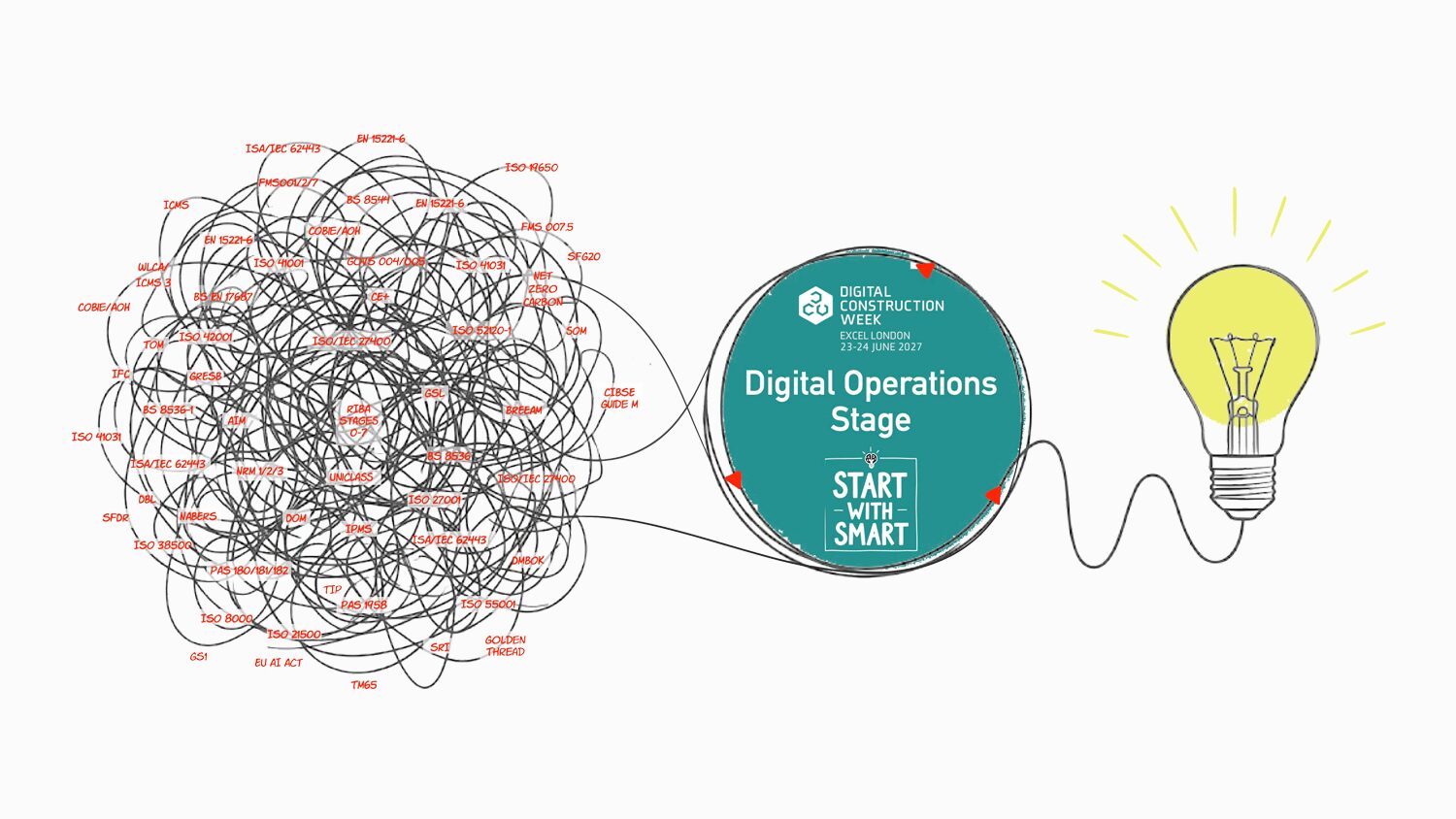
As the founder of Start With Smart and official partner of the Digital Operations Stage at DCW a fortnight ago, I facilitated the panel sessions mapping these dynamics. Walking off the stage at DCW, the underlying friction defining our industry felt more tangible than ever. We had some major breakthroughs at the event. The Digital Operations Working Group (DOWG) co-founders presented the initial foundation logic for our Digital Operations Playbook. We also formally announced our strategic collaboration with nima and the Construction Leadership Council on the Information Management Initiative. On paper, the trajectory looks clear and momentum exciting, but on the ground, the reality is far more fragmented.
My role within the DOWG is strictly that of a facilitator. I am not an enforcer of technical standards on the delivery side, nor am I a BMS engineer at the coal face of operations and maintenance. But when you facilitate three distinct panels across the Digital Operations Stage, you are forced into an intensive exercise of reflective dot-joining. You begin to see where the individual links of the project lifecycle are holding firm, and exactly where the chain snaps.
This is not the final word. It is a live playback of a conversation that is still unfolding across the market. I am putting it forward to show how our roles, standards and engineering practices need to connect in the real world. We have to stop working in isolated, and far too often passive-aggressive vertical silos, if we are to finally plug the project-operations gap.
The building blocks of the playbook framework logic rely on some very specific alignments. During the Foundation and Flow fireside chat, DOWG co-founders Steven Boyd MBE and Gordon Mitchell FIWFM mapped out exactly what is required to make asset management actually work for operations. Their current work focuses on understanding the business reasons for asset management and aligning established cost and maintenance classifications, specifically NRM, ICMS and SFG20, so they can directly feed the government’s FMS002 operational standard. This is all anchored by the macro BSI and ISO governance frameworks.
“The industry assumes that clients inherently possess the internal data architecture capability or the expertise to author these complex technical specifications in-house. They rarely do.”
We are putting this logic out to the market now to get a direct sense-check. We want raw feedback because the goal here is to actively involve the wider industry in developing this framework. It cannot just be a closed committee piece.
This business outcomes baseline is what defines our key user personas and their operational ‘jobs to be done’. But standards do not execute themselves. For this framework to work, the operational outcomes defined at the outset must actively drive the technical design, specification and procurement. This requires a strict right-to-left pull that ensures a consistent asset identity, deliberately ensuring that the data transferred at handover is fit for operational purpose, rather than just a traditional left-to-right compliance dump.
Crucially, this logic challenges a systemic, false assumption deeply embedded in the sector. The industry assumes that clients inherently possess the internal data architecture capability or the expertise to author these complex technical specifications in-house. They rarely do. Expecting clients to blindly mandate these heavy structures without an operational translation layer is why so many digital strategies fail before a single brick is laid.
When an organisation copies and pastes unexamined compliance standards into a tender pack, they aren’t protecting the asset. They are simply creating a technical vacuum. It ensures they will be sold expensive, unmaintainable data repositories that offer zero day-two utility.
Even with clear policy rules, frameworks fail without a technical mechanism to enforce them. This brings us to the smart buildings specialist and the evolution of the master systems integrator role (ie master systems coordinator), as a focal point of the panel discussion I moderated with the deployment teams from One Sightsolutions and Klimatica.
There is a widespread fallacy in the market that simply adopting a new handover schema will solve the industry’s data disconnection. The sector is currently watching buildingSMART’s international evolution from COBie to the Asset Operations Handover (AOH) framework. But a data schema is not a management standard. It does not define a repeatable process, continuous improvement or real-world operational governance. Nor can a collection of schemas be shown to work together and align automatically to form a management function. The DOWG’s playbook addresses this gap directly, establishing the missing crosswalks and operational alignments required to transform technical frameworks like AOH into functional management workflows.
“A data schema is not a management standard. It does not define a repeatable process, continuous improvement or real-world operational governance.”
This structural disconnect is blindingly obvious when you examine the types of data required to run an estate. Legacy procurement is trapped in a loop, focusing entirely on asset data. This is the static description of a physical part, telling you what it is, its serial number and where it sits. It is a world of dead nouns. It can tell you a pump exists, but it cannot tell you if it is failing.
Running a digital operating model requires performance data. This means the real-time, time-series telemetry streams that measure actual behaviour, energy usage and cost. This is the world of live verbs. To achieve true data continuity, you do not just need an immutable, system-agnostic barcode stamped on a machine during construction. You need a reliable way to link the static asset data to the live performance data within the true context of how those systems interact. If you don’t map the operational relationships between those assets, the data cannot actually deliver for operations and maintenance over the long haul.
In the second part of this series (to be published on Thursday 18 June), Kirby moves from data theory to frontline execution. He explores how an MSC smart buildings specialist role uses an independent data layer to map these states and forces conflicting procurement documents into alignment, and how advanced digital commissioning uses frameworks to secure true operational stability from day zero.
Keep up to date with DC+: sign up for the midweek newsletter.