


Nemetschek’s AI guru Julian Geiger: construction needs industry-specific AI tools
14 September 2026

How do you manage a career in information management and digital construction? DC+ asked three people at different stages of their careers that very question during Digital Construction Week (DCW).
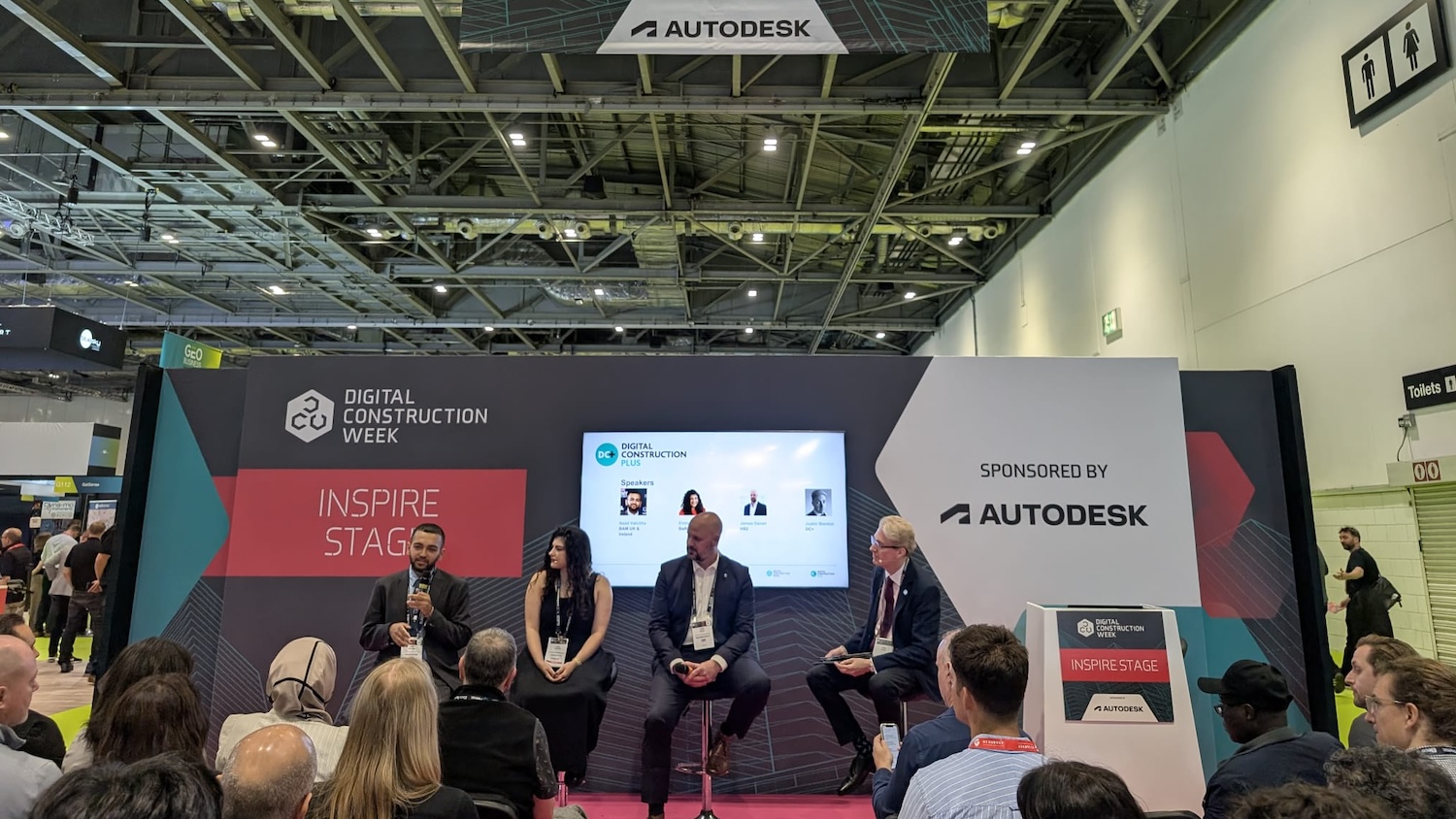
On the Inspire Stage on day one of DCW, DC+ brought together: Asad Vatchha, a recently graduated apprentice and digital project solutions engineer in BAM UK & Ireland’s London business; Emine Taylor-Unlu, assistant information manager at Balfour Beatty Vinci (BBV), working on the HS2 Area North contract, and Digital Rising Star of the Year 2026; and James Daniel, head of digital engineering at HS2 Ltd.
Vatchha represented the start of a career. “I didn’t take the traditional education route. I started as an apprentice 3.5 years ago with BAM,” he said. “It was a series of coincidences – a combination of careers fairs and a growing interest in apprenticeships and a new way of learning. Because learning and memorising theory isn’t the easiest for me, I thought I needed something different – I needed to be hands-on. I saw two different companies starting to embrace apprenticeships in this new industry, digital construction, and I thought, let’s take a leap now.
“Construction wasn’t my only opportunity; I did look at other avenues, but when I started to learn more, and as I’ve learned more about construction, I’ve grown more in love with it.”
Taylor-Unlu represented a career gathering momentum. “I joined BBV as a GIS coordinator, but I really enjoyed spatial data,” she said. “I didn’t really learn anything about information management before I started, but in my time at BBV, I started to enjoy the fact that information management really was the glue binding everything together. I really enjoyed pulling together assets through document control, GIS and CDEs. Then, over time, I got my skills, and applied for [my current role] of assistant information manager, and I love how it touches every single department within construction.”
DC+ asked the pair how they see their careers progressing and whether there’s a clear path for them to follow. Vatchha said: “I think my career path is definitely more defined as of now. There is still flex and constant movement in such an ever-growing industry, but for me, it doesn’t make a difference at the moment – I take life in stages. I’m looking at what I need for my next [stage]. Do I want further education? Do I want to specialise in certain subjects? My interests may change, and I might decide to specialise in visualisation in the future, or possibly information management.
“I believe my career path will continue to be defined by our understanding of what the limits of digital construction can be. I want to be someone that can be trusted in the industry, not just within my own company – so when I speak about BIM, people understand and it resonates with them.”
Taylor-Unlu answered: “Over the next five years, I’d like to become an information manager. So many other industries have a set accreditation path to get recognised, but often information management is left behind. I think accreditation is something I’d like within the next five years.”
The discussion turned to the notion of the ‘squiggly career’ – a non-linear path where progression is not simply up the ladder, but also lateral and even down the ladder in order to acquire new skills and experience. Do the two younger panel members expect to embrace a squiggly career?
“Yeah, definitely,” said Vatchha. “I don’t think it’s going to be as squiggly as it has been in the past, but there are many different specialisms you can go into, and I might start specialising in something and then realise it’s not for me once I learn more about it, so I might have to return to certain subjects, and then continue my progression.”
Taylor-Unlu responded: “I think you should embrace a squiggly career. Within information management, you could go into nuclear, you could go into production, you could go into highways and tunnelling. There are so many different aspects you need to consider within each infrastructure sector. Sometimes I think it’s better to take a wider scope, especially in earlier years, and don’t – pardon the pun – tunnel yourself in to a precise area of information management.”
James Daniel has enjoyed a squiggly career. Before his current role at HS2, he worked for Willmott Dixon, URS Corporation, Aecom, Skanska, and Kier Highways. He revealed: “My degree was in interior design. My first job was designing nightclubs, but I then moved into community environments, looking after sick children, designing specialist environments for them. Then I moved into housebuilding, and then moved into heavy infrastructure, both vertically and horizontally. So, I’ve had a very, very squiggly career.
“You can argue it’s partly by design, because when I first started my career, I really wanted to chase something that was more architecturally based or digitally based, but my first few jobs didn’t have those opportunities, so I kind of ebbed and flowed to try to find a way forward to get where I am now.
“I think a lot of people leapt or fell into this career path in 2010/11 [with the start of the BIM mandate], thinking ‘this BIM thing looks really interesting’. What’s really wonderful is the richness and diversity within this part of the industry. I think it’s probably the best part to be in right now. You can come from many backgrounds, any kind of specialism, whether it’s design, architecture, engineering, analytics, systems, computing, whatever. You can find a path that really gives you some of your own squiggle, if you will, to really make your own within this part of the industry.
“I don’t think my career is going to be any more straighter going forward. I hope it isn’t, to be honest with you. I hope it remains squiggly, because it’s that much more interesting and diverse. The richness of what we’re doing is something I hope that I can pass on to other people.”
To conclude the debate, DC+ asked the panel if information management could be recognised as a discipline in its own right, even a profession.
Daniel answered: “I think it needs to be a discipline that’s respected in the industry, because the challenge is that you’re working with professional chartered engineers, architects, surveyors – they have that professional status. I think there should be something that mirrors that from a digital perspective, so you can walk into a project, an office environment, and have that [same] level of credibility.
“There are already accreditations for information management, and degrees and Master’s degrees, so we’re heading towards that. But I think we have to be very careful about how we consider [information management] as a professional qualification. We need to be mindful of not alienating or isolating specialists from other backgrounds.”
Taylor-Unlu echoed his sentiment about the information management function being respected, and how project teams can benefit from embracing IM to help get projects right first time. “Typically, the industry has the money to sort things out when a project goes wrong, but doesn’t have the money to do it right in the first place. We need people to take information management a lot more seriously. I think the only way you’re going to do that is make it a distinct discipline, and that way the industry will be able to get it right first time.”
Vatchha offered a different outlook. “Yes, there should be specialists in information management, but if you think about it, any project can have hundreds of thousands, millions of documents or files that are posted to the CDE or in emails etc, that’s nearly impossible to manage if we have a singular discipline. Across a project, you might have thousands of people producing these documents.
“The question we should ask is: who is responsible for creating the information? It’s all of us. We all have a part to play in it, and if each person takes an extra 30 seconds, maybe even five minutes, to follow the correct [information management] processes from the start, [then projects can start right first time].
“There will be time [during a career] to learn the basic protocols, and when you’re not sure of something, you can go to the specialists, and they can give further advice. But the basics like file naming, correct provisioning statuses, those should become second nature, and once it becomes second nature, a project can end up working a lot smoother.”
Keep up to date with DC+: sign up for the midweek newsletter.