


Manufacturers’ Information Hub passes first test
18 September 2026

McLaren Construction isn’t content with simply deploying Boston Dynamics’ Spot the robot dog at scale: the four-legged robots will monitor and scan the contractor’s sites autonomously. DC+ spoke to McLaren’s Tom Gothard and Thomas Flannery to find out more.
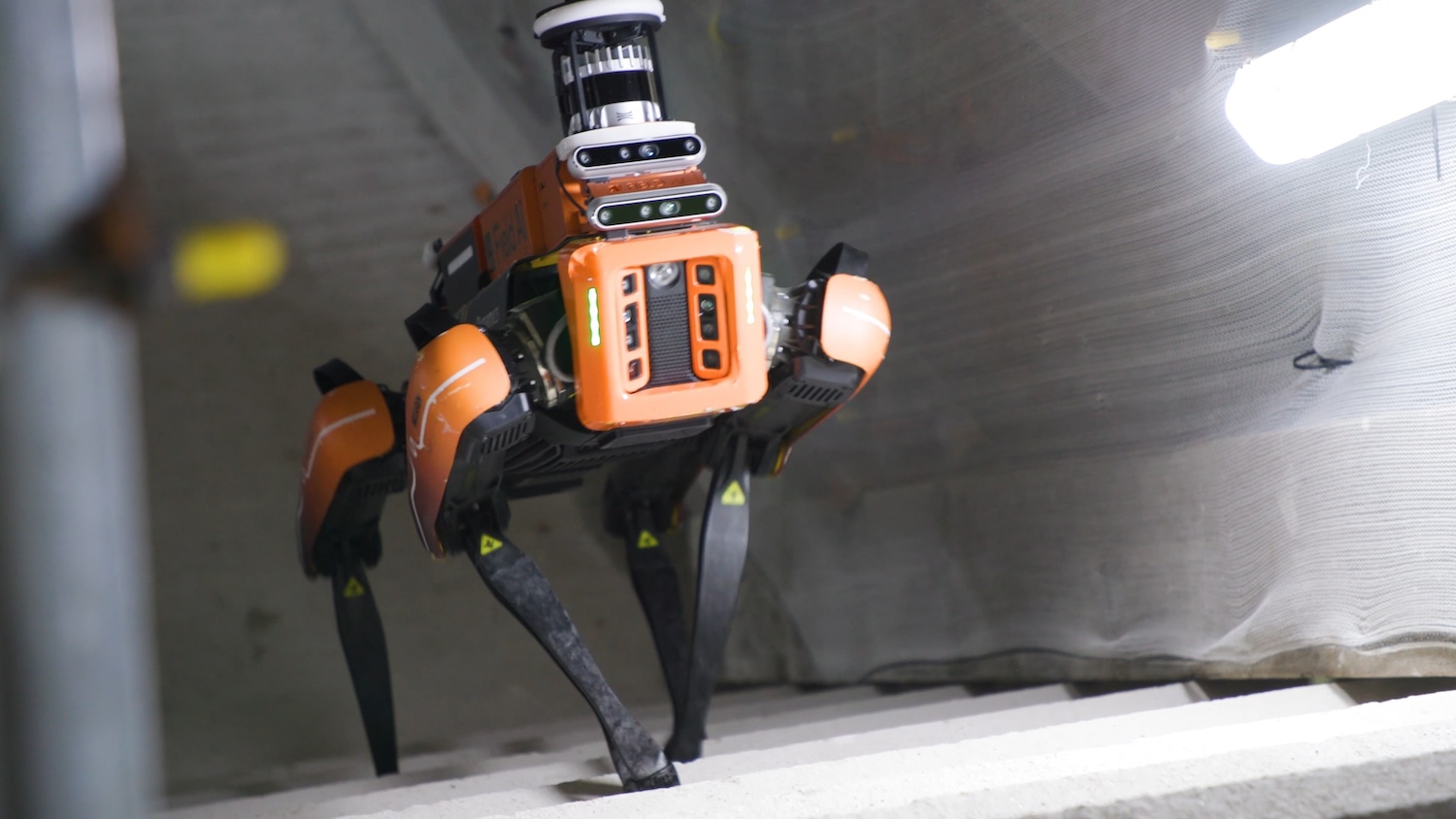
The robot dogs are supplied by California-based startup FieldAI. The latter has fitted its Field Foundation Models technology to the robots, giving them autonomy.
The models combine data-driven AI with physics-based reasoning and uncertainty quantification to unlock environments that are otherwise too complex and unpredictable for robots. FieldAI’s partnership with McLaren marks its UK debut, after success in Europe, Asia and North America.
Initially, McLaren will use Boston Dynamics’ Spot the robot dogs with FieldAI’s technology to capture 360-degree site imagery (uploaded to OpenSpace) for progress verification, generation of point cloud data (uploaded to the Naska platform for model-to-site deviation analysis), safety compliance patrols and quality assurance.
Autonomy was a key factor in McLaren choosing FieldAI. McLaren senior digital implementation manager Tom Gothard explains: “We came across FieldAI through one of our enterprise technology vendors; they had a contact there and they put us in touch with them. The autonomy was something we were definitely looking for, because we didn’t want to have our own people managing these robots day-to-day. We wanted them to be autonomous and almost take a load off of our construction team.”
McLaren began testing the FieldAI robot on site last December. Among the projects to have tested the dog is the Passivhaus refurbishment of the London School of Economics and Political Science’s building at 35 Lincoln’s Inn Fields.
FieldAI, founded three years ago, is led by a team with backgrounds at Nasa’s Jet Propulsion Laboratory, DeepMind, Google Brain, SpaceX, Amazon and Tesla.
Last summer, the startup raised $405m from the likes of Bezos Expeditions and Nvidia’s venture capital arm. It had previously secured investment from Bill Gates’ venture capital business and Samsung.
Its technology is already in use on “hundreds of sites” in Europe, Asia and North America.
The contractor will focus deployment, at least initially, on sites where the technology will have the most impact. Thomas Flannery, head of digital information management at McLaren, tells DC+ that the deployment will embrace the variety of sectors McLaren works in. “We do data centres, arenas, commercial, fit-out, residential. We want to understand which sectors the technology will bring the most value to,” he says.
Naturally, for a project to feature in the initial deployment, it must have “robust approaches to digital construction and good-quality models coming through the design team”, he notes. McLaren will also liaise with its clients. “A lot of our clients are very keen to see what we’re doing in this space, and they’re very open and receptive to seeing this technology on their sites,” Flannery says.
Gothard explains how a typical deployment will begin: “FieldAI will train the dog on the site environment; they’ll input data, such as the drawings and models. [A few months later] we’ll take over the set-up ourselves with some light-touch management from FieldAI.
“The robot will conduct mapping walks. It starts to collect data – LiDAR, point cloud, photogrammetry – and starts to understand its environment in its current context. Then we feed it the drawing as well, so it has something to relate that in terms of a floorplan. The models are helpful, but not necessary.”

“We’re challenging our project teams to come up with practical ideas of what else the FieldAI dogs can do: we’re asking what they’re trying to track in their project, what their key construction risks are.”
Once the robot ‘knows’ the site, its mission and schedule are set, including “what it’s going to capture and any exclusion zones – such as a concrete pour”, he adds.
The logistics will need to be factored in. Gothard explains: “Say our project’s got a floor area of 30,000 sq m: how many walks is that and how does that affect the dog’s battery life? How often does it need to go back to its docking station, charge up, and then redeploy? What time will the robot do its walk: before starts, at lunchtime, or after work finishes?
“We would like the dog to conduct daily walkarounds for general 360-degree capture, just so we’re never missing anything, any part of the installation or any step in the construction of our projects. Capturing point cloud data will probably be at a lower cadence; otherwise we’ll be overprocessing the data: there’ll be too much to handle and make sense of.”
Flannery adds: “The dog will walk the site, do the point cloud capture, and go back to its docking station. Then the point cloud data will [be fed] to the Naska module. With the models already there, Naska will do the comparison. It takes a day, maybe, to turn it around. Now we’re discussing with Naska about getting the outputs and getting those straight to who needs to see them – obviously the quality team and the site manager – so they can let the subcontractors know what needs to be fixed before they have moved on from that area.”
Flannery describes McLaren’s move into autonomous robots as a three-year commitment. “If the primary use cases [the photogrammetry to OpenSpace and the point cloud scans to Naska for deviation analysis] are satisfied, we’ll see a return on investment. Anything else over and above that is a value-add,” he says.

“A lot of our clients are very keen to see what we’re doing in this space, and they’re very open and receptive to seeing this technology on their sites.”
Gothard cites the cost savings of having the dog carry out the photogrammetry on a project – rather than site managers – at £30,000 to £35,000 a year. The added benefit is the site manager having their time freed up to concentrate on “what humans are better at – which is talking to people, having those conversations, looking out for certain items, whether it be health and safety, quality, environmental, those sorts of bits on site”.
The FieldAI dogs also represent a significant saving on laser scan surveys.
But it’s not just about the primary use cases: McLaren’s digital team is alert to other opportunities that may arise. Gothard adds: “We’re really just getting started on full deployment onto projects now. I think this is the stage where we’re really going to get the most lessons in terms of building out the ROI case, understanding what the technology’s full capabilities are. We’re challenging our project teams to come up with practical ideas [of what else the FieldAI dogs can do]: we’re asking what they’re trying to track in their project, what their key construction risks are.”
Flannery notes: “I’m not going to name it, but on one project, the team’s got a real issue with intumescent paint on the steelwork and tracking damage. We’ve developed a use case with FieldAI to get the dog out scanning once the steel’s installed, and then feed that back, getting the data as quickly as possible to understand where the damage is on site, because it’s quite a lot of steel.”
Of course, McLaren’s move isn’t just about improved efficiency and quality for the sake of its own bottom line. “We’re getting a lot of projects now that require us to validate every piece of installation,” Gothard states.
The initial plan is for the robot dog to conduct its walkarounds at lunchtime or at the end of the day, “so it’s not directly interacting with people”, says Gothard. “FieldAI has a very good health and safety record.
“But we’re talking to our project teams about planning the logistics and the practicalities of having this on site, including its walking routes. What if there are doors? We’ve looked at one project where the dog may step on to the hoist, the hoist driver gets in and drops the dog off at different floors to avoid the dog having to interact with people on the stairs.”
As well as considering the health and safety risks of having the dog on site, Gothard envisions health and safety benefits. “We’ve looked at FieldAI identifying hazards – maybe emergency exits that are being blocked by materials, trailing cables that could cause trip hazards, poorly stored materials, or missing fire extinguishers, all sorts of stuff like that, really, which it can do without anyone being on site working.”
McLaren’s data security officer reviewed the agreement with FieldAI, not just with a view to the contractor’s policies, but also clients’ stringent data security requirements. “Our data will be kept on UK servers, and FieldAI won’t be able to train its AI model on our data,” Gothard states.
McLaren is planning to trial a bricklaying robot, “not to replace humans, but to meet skill shortages”, says Gothard.
The contractor’s digital team has also recently coordinated a group approach to deploying drones. “Obviously, there’s quite a developed regulatory framework around deploying drones, so we have to follow quite a specific process for that, and I’m sure robotics will probably catch up to that,” Gothard notes
Flannery emphasises that these developments are part of McLaren’s ongoing digital transformation. “It’s taken four years of work. Our investment plan since 2022 has seen us rationalise our technology stack and invest in individuals like Tom – he’s not only the implementation manager for FieldAI; he also brought Dalux on to our sites as well. Our data stack is now in a position where we can start leveraging AI across our project portfolio. That investment has got us to this position now where we’re confident that deploying AI-enabled autonomous robots on site will be a success.”
Keep up to date with DC+: sign up for the midweek newsletter.