




Manufacturers’ Information Hub passes first test
18 September 2026

The Manufacturers’ Information Hub (MIH) is working on a proof of concept to enable construction product information to be shared directly from manufacturers to the users of that information. MIH founder Alex Small lifts the lid on the platform that will enable a crucial step towards the golden thread and wider digital transformation.
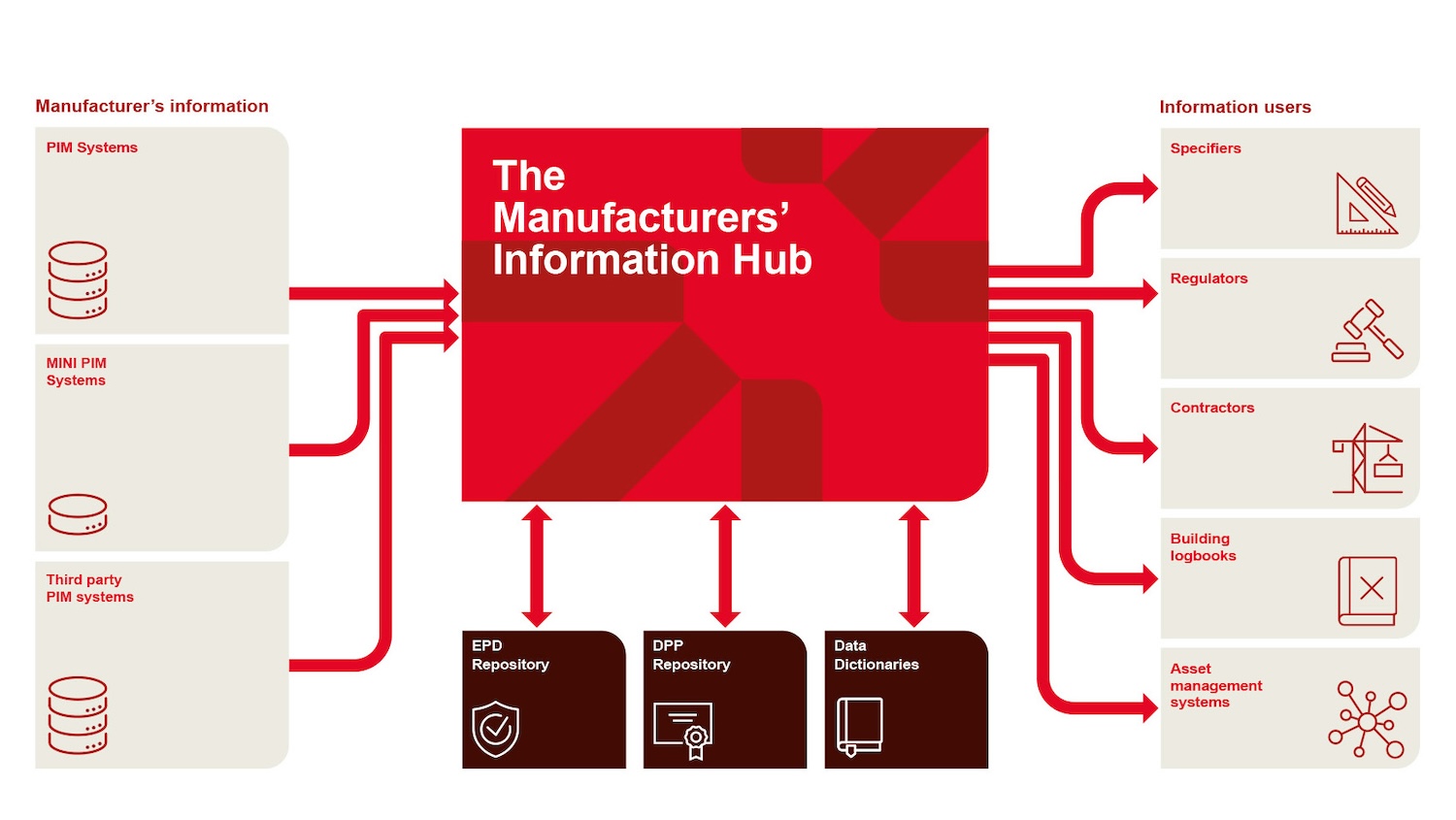
The MIH is a not-for-profit initiative established by manufacturers to simplify access to construction product information through a standardised, interoperable approach. It is intended to be a single gateway that enables information to flow more efficiently between manufacturers, designers, contractors, distributors, digital platforms and asset owners.
The approach – inspired by the Amadeus system in the travel industry – is intended to reduce duplication, improve data consistency and support emerging regulatory and market requirements around traceability (the golden thread), digital product information (digital product passports) and compliance.
The MIH was founded and is led by Alex Small, digital platforms and innovation lead at Tata Steel UK. At Digital Construction Week (DCW) last week, he announced that the MIH had secured support from UK Research and Innovation (UKRI) – as part of the Industrialising and Digitalising Construction Research and Innovation Challenge – to deliver a proof of concept (PoC) by 31 August.
Small has led the development of the MIH for nearly three years, so it has hit the ground running after gaining UKRI’s support. He told DC+ on day two of DCW: “The PoC is set at TRL3 (Technical Readiness Level 3). The priority for us in the next three months is to look at what sort of technology we’re going to need to build this. In particular, what are the pain points? What are the most complex areas? We need to prove to UKRI that we have overcome those, and then also prove that this will be something that will support the Industrialising and Digitalising Construction challenge.
“We’ve also had a few requests to try to work with other areas of government, like the Ministry of Housing, Communities & Local Government (MHCLG), that are looking at manufacturers’ information. The MHCLG’s construction products reform white paper talks about the need for digital product passports, or at least the information and product identifiers related to digital product passports, and the idea of a construction library.
“We are talking to MHCLG because we think the MIH is the perfect back-end to a construction library. There is an element of trust that comes from the MIH because it’s a governed source of information – it pulls the information directly from the manufacturers’ own, managed, digital systems.”

“We are talking to MHCLG because we think the Manufacturers’ Information Hub is the perfect back end to a construction library.”
Small explained that the work on the PoC is focused on the two halves of the hub: the means by which product information is collected and standardised, and the means by which it can be accessed by the built environment supply chain (as illustrated in the infographic above).
“The first part really is the data dictionary and enabling the access of the correct data properties for a product. When you, as a manufacturer, connect to the hub, you’re saying to the hub, ‘please give me all the properties that are related to my product, structured in the right way for the hub’ – that could be Uniclass, Omniclass, the ETIM dataset or your IFC schema, the digital product passport data set, or whatever. We need to then use some smart data ontologies to give a clear set of properties for manufacturers to map their systems to,” Small said.
The MIH is working with a not-for-profit organisation, part-owned by a national construction product association in Europe, that has given Small and his team free access to their data dictionary. “We can populate that for the PoC. We will then evaluate whether that is the right platform for us to use long-term,” he added.
It is worth noting that the genesis of the MIH is Europe’s drive for digital product passports. The UK government has already stated its plan to follow Europe’s approach. Thus, while being supported at PoC stage in the UK, the MIH has a pan-European vision. The MIH has a “wonderful, highly experienced, highly knowledgeable technical working committee, led by Thierry Berset”, who is the chair of Construction Products Europe’s digitalisation task group and head of global product conformity at Sika.
The MIH will also work closely with Data Yard, a data pool for product information for builders’ merchants.
Small then explained the second half of the PoC: “Then we have the information exchange layer – that is the digital platform enabling the swift transfer and exchange of interoperable information through the hub and out to whoever needs it. For that exchange layer, we’ve engaged the company that solved this challenge for the music industry. Within 45 minutes of us presenting this idea to them, they’d written out and drawn out all of the high-level IT architecture for this in an instant. They act as the many-to-one, one-to-many for global music rights, with each song carrying metadata music rights.”
He noted: “The really complex bit is making sure the two parts of the hub come together.”
Naturally, cybersecurity is also a factor for the MIH: “We need to make sure that the site is secure, the data is secure and that we aren’t a cybersecurity risk for anyone using the hub.”
“You can’t have the digital transformation of construction without having structured, available and interoperable product information providing the foundation. Everything else is built from that.”
Given that there are 430,000 construction product manufacturers in Europe, nearly half of which employ fewer than 10 people, the MIH’s role isn’t entirely limited to providing a technical solution to a massive problem; with digital building logbooks and digital product passports on the horizon – but with little actionable detail at this stage – the SMEs among the manufacturers need a helping hand.
Small explained: “We see ourselves as two things, really: one, we are an IT startup; and two, we’re a trade association. We see it as part of our duty to help, advise and support manufacturers in making some of those key product information decisions. As a result, a significant part of our effort is to improve engagement with manufacturers.”
“We are discussing further support with the UK government should the PoC be successful,” Small said. Funding from the EU is being sought.
Assuming the PoC is successful, the intention is to build a small-scale working version, from which the MIH can then run a series of pilot projects. Given that cement and structural steel will be two of the first products to be required to have digital product passports, they will feature in the first tranche of pilots.
Small also offered some examples of other pilot projects: “Can we do something that triggers an automatic goods received note digitally when a product is scanned and arrives on site, that then triggers an automatic invoice to be sent by the manufacturer?
“One of the things that James Franklin, digital twin director at Kier, loves about this is it enables them to start doing tagging and tracking of products.”
Indeed, Bovis and Sir Robert McAlpine, alongside Kier, are cited by Small as early supporters of the MIH. He is also talking to BAM, Willmott Dixon and Balfour Beatty, and Skanska in Europe.
Supporters from the other side of the industry in the UK include Knauf, Sika, Etex, Siderise, Heidelberg Materials, Wienerberger, Kingspan, Saint-Gobain, Tata Steel UK and GS1.
Looking further ahead, 2027 is “about scaling, onboarding, promotion, making people aware of what we’re building, getting people involved on a pan-European basis”, Small explained. “And then 2028 is when we hope to have something that is usable. It’s going to take us 10-plus years, probably, to get all the properties for all the products.”
Through participating in the MIH, manufacturers retain full ownership and control of their data and automatically become co-owners of the hub. “The goal is to secure enough pan-European government funding for us to get to the stage where the MIH is useful enough to contractors and others pulling information from it that there is a value for manufacturers to start paying monthly subscriptions. We think this will be in the realm of a few hundred pounds a month, not thousands of pounds a month, no matter what size you are.”
Small concluded: “You can’t have the digital transformation of construction without having structured, available and interoperable product information providing the foundation. Everything else is built from that.”
Keep up to date with DC+: sign up for the midweek newsletter.