



Nemetschek’s AI guru Julian Geiger: construction needs industry-specific AI tools
14 September 2026

No, this isn’t a late April Fool’s story: a concrete vision for humanoid construction robots, available as a service, working on live sites from 2030 has been unveiled.
The vision belongs to Vassos Chrysostomou, founder of IBE Humanoids. He is also the founder and managing partner of sister business IBE Partnership, which has helped bring ConstructCO2, the Nialli visual planner and Aiforsite to market.
Chrysostomou detailed his vision during a humanoid robot summit in late April attended not only by academics and robotics developers, but also by large and medium-sized contractors (including Mace, Laing O’Rourke and Baxall Construction) and industry stakeholders. The summit was hosted at the University of Westminster and supported by the likes of the National Federation of Builders, Cranfield University, University of Warwick, Constructionarium and Innovate UK.
“Humanoid robots are coming to the construction site. Like it or not, they’re just around the corner. They’re not five years away, they’re not 10 years away or 15 years away: humanoids on your site will happen this decade,” Chrysostomou told the 100-strong summit audience.
He wants to establish a consortium, pulling together academics, construction industry leaders, and software and hardware developers, to develop and bring a multi-tasking/multi-skilled labour platform (a so-called “workforce multiplier”) to market.
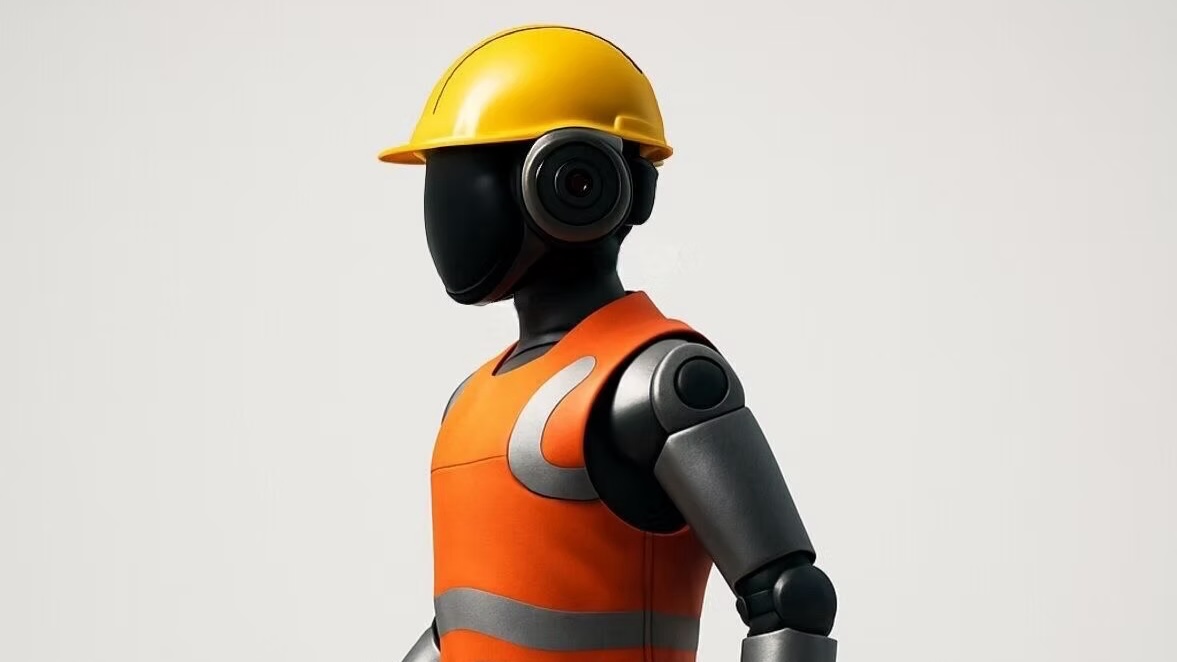
Leo, as the humanoid robot is named, will undertake tasks that are hazardous, repetitive, physically demanding, or undesirable for humans, as well as tasks that rely on consistency, monitoring or operation outside normal human working hours. Chrysostomou emphasised that Leo will augment rather than replace human judgement, skill and responsibility.
“We want industry leaders to join us and inspire [Leo], define it, develop it, test it, take it apart, make it sure it works with [construction industry] processes and workflows, and on the projects to make sure that when the robot’s ready to go out on a construction site, it actually begins to add value from day one,” he said.

“Humanoid robots are coming to the construction site. Like it or not, they’re just around the corner. They’re not five years away, they’re not 10 years away or 15 years away: humanoids on your site will happen this decade.”
The first step is the creation of an advisory board to plot the robot’s development roadmap.
Then, Leo will need to be trained. “We can’t put Leo next to a bricklayer, a dryliner or a painter, and say, ‘show Leo how to do it’. To train Leo, we need to gather data, data, data – and that data sits with the industry,” Chrysostomou explained. “The more data we have, the quicker and more accurately Leo will be trained and adapt to the needs and requirements.”
That data will be input into the so-called ‘humanoid simulation college’: a virtual world in which the robot can be taught digitally. “Once you teach robots digitally and the hardware is ready to accept it, then you transfer that digital knowledge into the hardware,” he said.
Once this stage is complete, Leo will need to be tested in controlled laboratory environments, and then on a controlled site environment “with people working alongside the robot”. Chrysostomou suggested the 7.7ha test site at the Constructionarium in Bircham Newton could be used for the latter.
Once these gateways are passed, Leo will need to be tested by contractors on real sites.
Project delivery will take a clustered approach – each element being developed simultaneously. Clusters will be devoted to software development, hardware development, security/compliance/certification, health/safety/wellbeing, and human-to-humanoid synergistic training.
Chrysostomou noted: “We can’t throw Leo on a construction site without training the operatives. And we’ve got one million of them to train.” Such training could be conducted via augmented reality. “We’ll put the operatives through a virtual environment to work side-by-side with Leo in different environments, different scenarios, until such time as they are comfortable and ready to be able to work with Leo as part of their team.”
He outlined the funding challenge: “In the development stage, we’re planning to tap into Innovate UK and EU funding. We want industry, whoever is going to come on board, to support us in kind and in commitments.
“We were thinking of developing a tier-based monthly subscription (three or four different tiers, subject to turnover, vision and capabilities) for the industry to engage with us. We’re also open to bespoke arrangements – everything is on the table.”
“We’ll put operatives through a virtual environment to work side-by-side with Leo in different environments, different scenarios, until such time as they are comfortable and ready to be able to work with Leo as part of their team.”
He argued that those who engage early with Leo will gain a competitive advantage – they will be ready to deploy Leo with a soft landing; those not engaged will face more of a challenge deploying the robot for the first time.
Chrysostomou is talking to California-based Noble Machines about a joint development agreement to create Leo, using Noble’s Moby3 robot as the base. “There could be other options. I won’t go into politics, but that’s where we are at the moment,” he said.
He envisions a roll-out, backed by mass production, “in 2030 onwards”. Capital investment will be required.
He imagines Leo being supplied to the wider industry ‘as a service’ with a subscription-based model that could be based on hourly, weekly, monthly or even task-specific or output-specific rates.
One summit attendee asked Chrysostomou about his expectations for pricing Leo. He answered: “Let me put it this way, by 2030, Leo will be cheaper than what you’re paying for a labourer now.”
It’s not simply a case of developing and deploying robots to carry out existing tasks. There was a consensus among the audience that the biggest productivity gains from deploying robots will come from a reimagined construction process. Indeed, while Leo must adapt to construction, the industry should grasp the opportunity to adapt to Leo.
Chrysostomou told the audience: “We need to reimagine construction. That means changing the workflow. Working with the right academia, working with the right professionals in the industry, you will have the skills and knowledge and experience to help you develop your processes necessary for a [‘production-ised’] future.”
Highlighting other benefits of joining in the development of Leo, he added: “Don’t underestimate the supply chain that’s going to come and work with you, the talent, the new generation that will want to work with you, because you are seen to be the leader in driving and reimagining construction.”
Chrysostomou concluded: “Innovation leadership is no longer optional in construction. It shapes trust, reputation and opportunity. In a few years, hardware will not be the differentiator: everyone will have access to similar technology. The advantage will belong to companies that: know how to deploy it safely; have trained their workforce; have data, standards and credibility; and look prepared – not reactive. Early adoption is not about being first. It’s about never needing to catch up.”
Keep up to date with DC+: sign up for the midweek newsletter.