


CLM’s real-time visibility in fireproofing
14 July 2026

Formwork manufacturer Peri has released case studies showing how its 2016 acquisition of Swedish concrete monitoring start-up Vemaventuri is bearing fruit on big projects in UK and South Korea.
Many concreting decisions on site are still based on assumptions rather than direct measurement, which leads to slower pours, delayed striking and reduced productivity.
Peri Group has reported two case studies showing how digital monitoring is letting contractors make better decisions based on evidence.
Vemaventuri was a Swedish start-up specialising in remote sensing technologies that let contractors see exactly what’s happening inside formwork in real-time. Peri acquired it in 2016 and has invested in the technology.
Peri says the productivity gains are clear. Now, fresh concrete quality can be verified before it even enters the formwork. Concrete pressure can be monitored during a pour rather than estimated from theoretical assumptions so it can proceed at the optimal speed.
Filling and compaction can be confirmed in areas where visual inspection isn’t possible, avoiding expensive rework or long-term quality issues. Concrete strength can be tracked as it develops rather than inferred from time alone, so formwork can be struck as soon as the structure is ready, not simply because a certain amount of time has passed.
All this information is brought together in a single digital platform.
“Contractors naturally build in extra time and capacity to protect safety and quality,” explained Aaron Lucid, global partnership and channel manager at Vemaventuri. “However, real-time concrete data eliminates the need for overly conservative margins. It allows them to fully leverage the engineering built into their formwork investment, unlocking major time and cost savings without ever compromising structural integrity.”
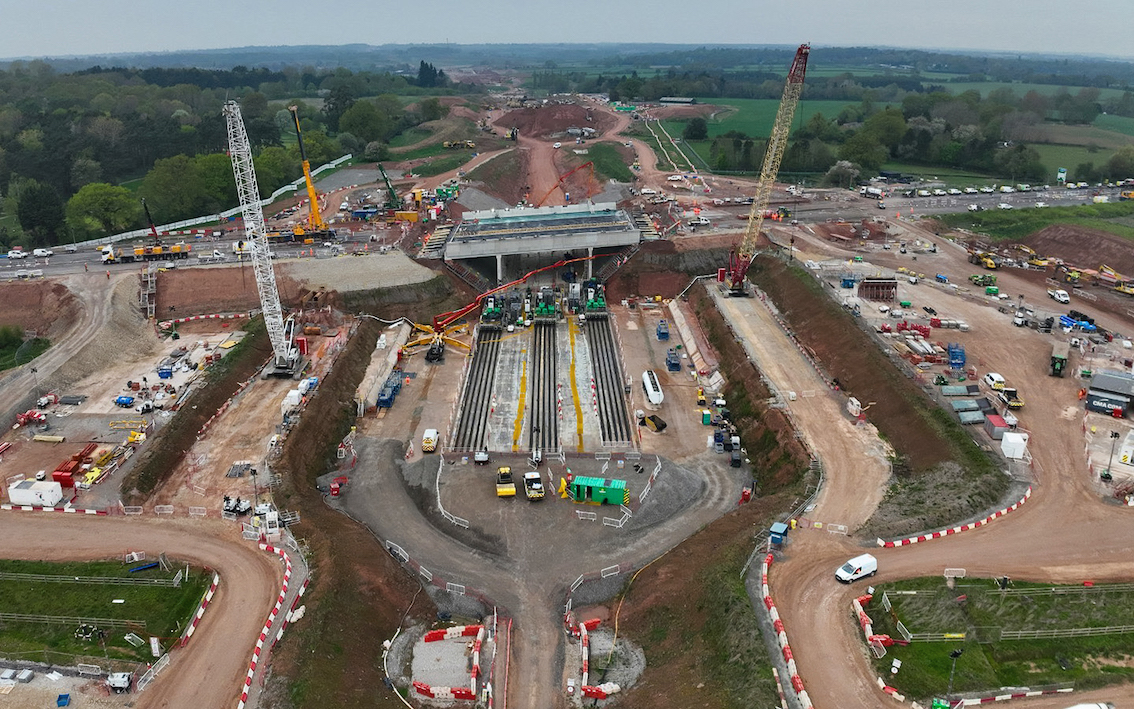
As part of the HS2 programme, Balfour Beatty and Vinci installed the A46 Bypass Bridge near Kennilworth using an innovative bridge slide technique that moved the 14,500 tonne concrete structure into position in just 18 days.
Once the bridge was in place, concrete infill was required on either side of the structure. However, the design included tall, enclosed voids with no direct line of sight, making it impossible to visually confirm whether concrete had fully reached every area.
Working with Peri UK and Vemaventuri, the project team deployed 24 Phono sensors linked wirelessly to a cloud-based monitoring platform. The system provided live visibility of concrete movement during the pour, allowing the team to confirm full coverage, switch pump lines when required, and maintain the required rate of rise throughout the three-day concreting operation.
In total, more than 800 cubic metres of self-compacting concrete was monitored, creating a digital record to support quality assurance and compliance. The result was not simply a smoother pour but verified evidence that the concrete had fully filled the required areas during a critical phase of the project.
“The Peri-Vemaventuri void sensors proved to be an invaluable addition to our quality assurance and control processes during the A46 bridge slide and associated pours,” said Maurice Dowling, works manager at Balfour Beatty-Vinci.
“They gave us the confidence, control, and traceability needed for a critical and complex operation.”
It’s not all about speed. Construction projects are becoming more complex as regulations tighten and demands on documentation grow. Information that once disappeared with the concrete is now expected to form part of the project’s quality record.
That’s where Vemaventuri’s Sono Hub digital water-content monitoring system came into its own in South Korea, where a series of high-profile structural failures led the government to mandate water-content testing of fresh concrete.
By replacing time-consuming manual testing with rapid digital measurement, contractors can verify concrete quality before it enters the formwork.
And the Phono monitoring system was developed to enable contractors to better detect incomplete filling and inadequate compaction inside complex formwork. The technology provides real-time confirmation that concrete has reached difficult-to-observe areas while also monitoring vibration, helping reduce the risk of hidden voids and honeycombing.
Peri urged the industry to stop thinking about concrete monitoring as an expensive project add-on and to think about the cost of uncertainty.
The company asks: “How much programme time is lost waiting for the confidence to proceed? How much plant, labour, or temporary works remain on site because the safest decision is to wait? What is the cost of discovering a quality issue only after the concrete has hardened? What is the value of having objective evidence if a decision is questioned months or years later?”
Peri also invites contractors to consider remote monitoring earlier, at the formwork design stage.
“Certainly, we can add Vemaventuri sensors into formwork at any time,” said Matthew Binder, national product manager at Peri UK.
“But the biggest benefits come when it’s considered alongside the formwork design from the outset. By combining engineered formwork with live monitoring data, we’re able to help contractors optimise the whole concreting operation, rather than just patching an individual problem. Ultimately, it’s about giving engineers greater confidence in the decisions they’re already making.”
Keep up to date with DC+: sign up for the midweek newsletter.