


BIM manager? Information manager? How to avoid being the wrong person in the room
24 November 2026

More than 250 buildings, more than 185,000 maintainable assets, 300 contractors and 6TB of legacy data and documents: digitising University College London’s (UCL) estate will be no mean feat. UCL and Amodal shared their journey so far at Digital Construction North last week.

As well as the key statistics outlined above, UCL head of data and digital estates Joe Jones noted that the university has nine higher-risk buildings and spends more than £170m a year on projects. He offered further detail of the university’s information challenge: “We have outdated requirements, no common standards for data and document management, large repositories [that have] grown organically over many years with inconsistent structure and unclear ownership.
“Our ambitions are to deliver a data-first culture with a commitment to ongoing transformation, investment in data quality, systems, resources, standards and requirements. We want to move to a single estate document repository within Asite, integrated with our IWMS [integrated workplace management system] platform and other asset and compliance systems in our infrastructure. Supply chain performance and compliance are key. We want to be able to measure this, report, and assure it’s all in one ecosystem.
“As a wraparound, we’re establishing data stewardship with recognised responsibilities and training for our teams to support the journey that we’re on. With quality assurance processes established, we then deliver reliable and accessible trusted data.”
UCL appointed Amodal 11 months ago to help it meet these targets. Amodal founder and managing director Thomas Whiting said: “[Rather than] starting from the beginning on a capital project, developing the information requirements and then building out, with UCL, we’ve had to start from the end and work backwards with the IWMS (MyCampus, which is based on Planon): [we had to understand] how all that data is mapped and stored within Planon, and then we’ve had to reverse engineer back how all that information is going to be within the buildings.
“In [terms of asset information management], we had to understand how we will structure that within Asite, and then actually design the documents to go into capital delivery projects to make sure they feed through, so we can actually connect the PIM to the AIM. But we’ve had to work backwards to work forwards.”
One key challenge is squaring the circle of Jones’s preference for agile delivery of the process and technology change with estate stakeholders being largely driven by detailed, Gantt-charted, waterfall programmes. There are also internal governance processes to consider. “We’ve got significant governance processes that we have to align everything to,” said Jones. “They’re complex and multi-stage, multi-stakeholder, with lots of different committee structures, lots of different financial commitments and committees that need to go through approvals. So we have to be fleet of foot and manoeuvre our process for the technology, particularly around some of the existing business needs as well.
“While doing all of that, we’re trying to focus on quick gains as well and getting to value quickly. That is key, and so lots of the things that Tom and I do on a daily and weekly basis is work out how we can try to deliver quick wins and deliver value while we’re still moving through a multi-year programme that will probably take three to five years.”
Changes need to be implemented in line with the team’s capacity to absorb those changes on top of their day jobs. Jones said: “We ask ourselves this question at every stage when we’re looking at implementing a release or a set of documents. We assess what changes are required and consider what the impact is on our users – what have they got going on in their day jobs that we need to profile against? We need to balance so we’re not overloading them.”
It’s no surprise that Jones and Whiting are focused on winning hearts and minds early on. The former said: “The key point for us is engaging with our operational teams at the early stage, rather than giving them a fixed result at the end. We want to work with them. We need to understand their problems, and we need to fix those along the way. We need to bring them on the journey so that they’re engaged, they feel part of the development, and they own it. Because if we want them to adopt it, we need their behaviour to change.
“CDEs and ISO standards are a new territory for many [UCL] people, so support is tailored and scheduled against each team or new project or new workstream release, rather than as a one-off training week. Our system and our process are quite tailored, so we only need to train people on the specific things that they need to know to do their job. We’re delivering phase change at a pace that’s manageable across our teams.”
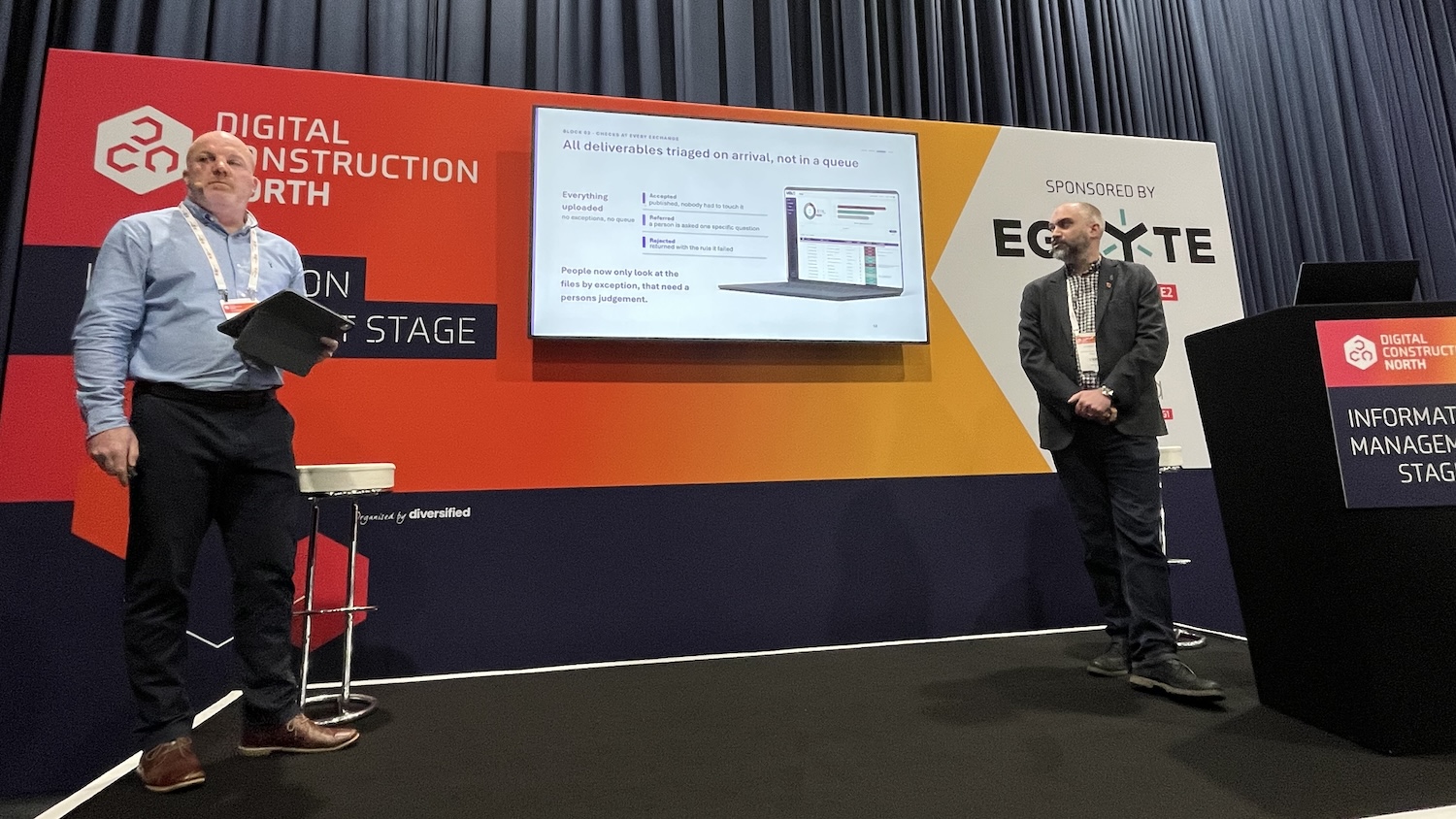
Due to the scope of the challenge for UCL, Amodal has deployed its technology, as Whiting explained: “UCL is going through a massive step change, so we’re implementing some of Amodal’s technology, which is effectively triaging all of the information on the way in. All the documents get checked at the point of upload into Asite, and it then works out whether the standards have been followed or not. So, instead of UCL having to develop a whole information management team with lots of people to check all the information, we can fully automate this as much as possible.”
For those delivering major transformation programmes across estates, Whiting offered this advice: “Write requirements that push people forwards, and ensure you’ve got assurance in that process and that those gates add value – you’re not just asking for things for the sake of it.”
Jones added that estates should not simply budget for technology procurement. “Technology is only part of the solution. It’s technology, people and process – it’s a holistic approach. It can’t be delivered without people. We’re investing in the right amount of effort and supporting people and cultural change.
“Delivering quick wins off the back of detailed business analysis builds trust, confidence with our stakeholders, opens doors to long-term relationship building between delivery teams and our key end-users. Buildings do not get smarter because we install technology; they get smarter when people trust the information behind them.”
“This is a big challenge for us. It’s somewhere in the context of 6TB worth of documents and files, four largely uncontrolled legacy document storage systems, from legacy CPUs to SharePoint to network drives,” Jones revealed. “We have millions of files generated over decades – lots of these documents are still being used day-to-day. We have poor document ownership, poor document version control, and as I mentioned before, multiple naming conventions – or none at all.”
He noted that UCL is not alone in facing this issue: it’s a common issue across higher education and healthcare estates. “Few of our peers, if any, can claim to have truly defeated the legacy data migration challenge, but it’s not just about mass migration. For us, it’s about selection, quality assurance, an approach where multiple metrics and business rules are being applied across millions of documents. We’re using AI and machine learning at solution and file level to handle the volume, identify the single source, isolate it and lock it down, cleanse as we go, make it digitally accessible for all of our users.”
Keep up to date with DC+: sign up for the midweek newsletter.