



De-risk your project by tackling information uncertainty
17 November 2026

Does your job title really describe what you do? Does your job title confuse your own team and your clients? Have you ever felt like you were in the wrong room at the wrong time? At Digital Construction North last week, Operam Academy founder Paul Shillcock unveiled a new capability matrix for the sector.

Shillcock’s capability matrix is born from his experience of running training courses: there are so many job titles in BIM and digital construction that confusion is rife. For example, does an ‘information manager’ manage information or produce information? [The Women in BIM Digital Construction Global Work Survey 2024 revealed a total of 87 job titles among 461 respondents – ed].
Furthermore, he noted one incident where an Operam customer struggled to get approval for their digital construction managers to receive information management training. The reason was simple: the company’s senior management team had renamed their ‘document controllers’ as ‘information managers’ and thus couldn’t understand why their digital construction managers should need training to do what the former document controllers were already doing.
Thus Shillcock’s matrix acknowledges this job title confusion and segments the sector not on the basis of job title but on skills and experience profiles, both vertical and horizontal. The matrix posits three profiles: information management specialist, information production specialist, and generalists (see image below). The further to the left you are along the management side of the matrix, the more process-focused you are; the further to the right of the production side of the matrix, the more technology-focused you are; and if you’re in the centre, you’re a generalist with a focus on people skills.
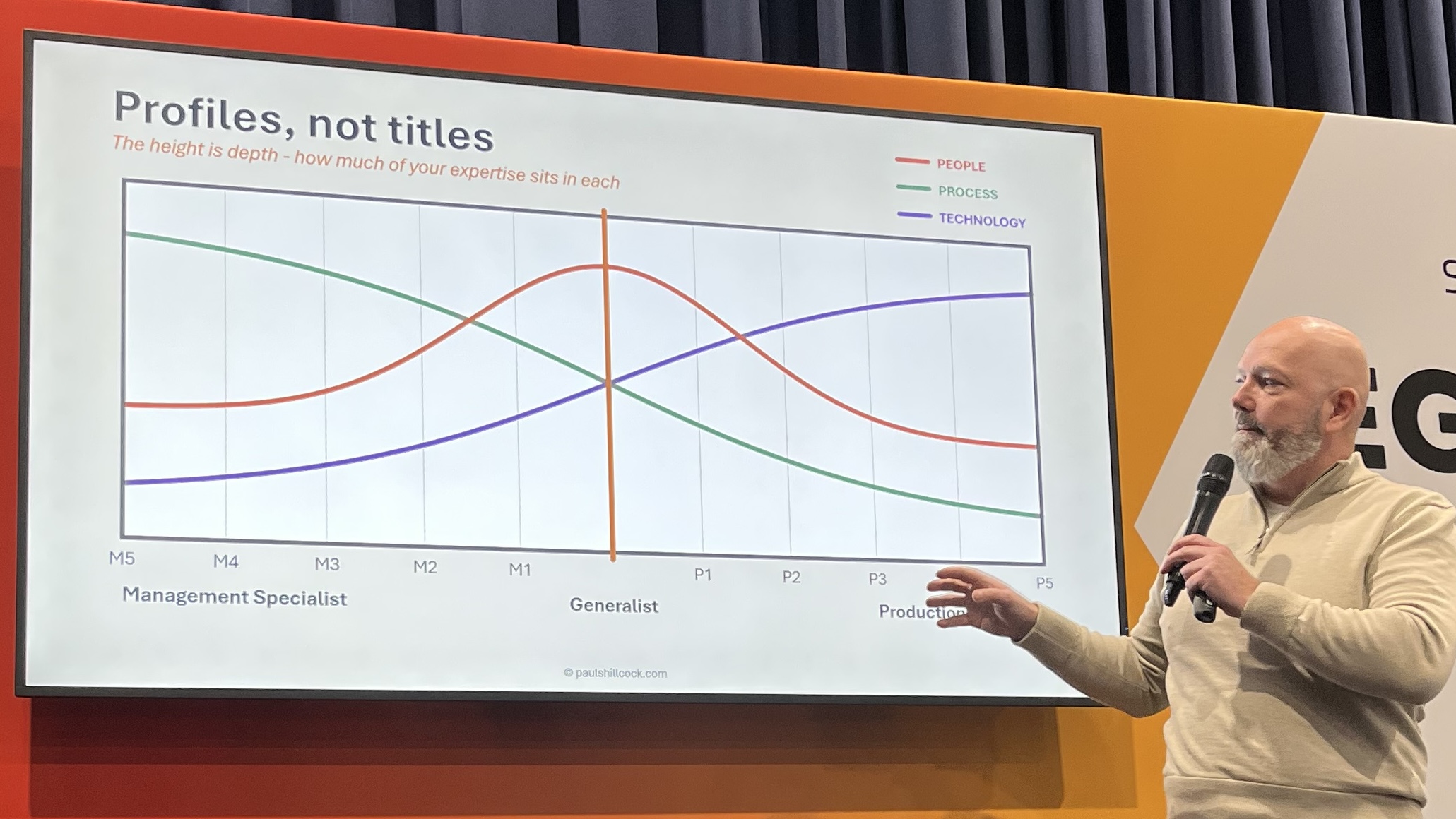
A live demonstration with four volunteers from the audience revealed not only that they placed themselves differently along that matrix, but also mismatches between their job descriptions and their actual knowledge and levels of experience.
Shillcock highlighted how the matrix can be used: “If you’re just starting out in this industry, then you can look at this from your point of entry. In my experience, people tend to come in around M2 – a project manager or asset manager – and architects and engineers tend to come in around P2.
“If you’re starting out, don’t think about what job title you want. Think about how you want to specialise. Do you want to go over to the left? Do you want to go over to the right? Which of people, process and technology gets you out of bed? Are you a natural fit? And then follow that path. If you want to specialise in management, and you’re weak on process, then that’s where you need to focus – and vice versa on the other side.
“The second use is if you’re mid-career. You might be a production specialist and you’re thinking that you’re ready to take that next step – how do you get there? You might be the best at production in the business, but you’re not getting looked at [for a promotion]. In my experience, the ones who do get into those senior leadership positions are the generalists – the ones who know enough about [information management and production], but have got really good people skills. They’re able to communicate. They focus on building relationships.
“If you’re a management specialist, learning a bit more about production and focusing in on those people skills [might be the way forward]. And it doesn’t mean that you have to be average at management or production, because if you want to, you can actually elevate [all your skills].
“The third purpose, if you’re already in that leadership position, is to use this to [review] where your team fits in. Map all of your team on this diagram based on what your objectives are or who your clients are. You can then ask: ‘Are we heavier to the left or to the right? Are we a team of generalists, and we haven’t got the specialism [we need]?’ Again, depending on what it is that you’re looking to achieve and the resources that you need, it could help with recruitment.”
Shillcock concluded: “Even if none of this applies, at the very least, what I ask you to do is to think about how you can get the right people in the room. If you’re setting up a meeting, think about what expertise you need in the room. Is it around the management activities? Is it about the production activities? If you get it wrong, apart from them being bored, you’re just wasting that person’s time.
“If you’re invited to a meeting, ask the question: ‘What is the purpose of this meeting? What will we discuss?’ If you haven’t got that expertise or the knowledge or experience, then say so. There might be someone better who can go in that room. I leave you with this. Job titles are generally something that is given to you by others (your employer or your client), but your profile, which actually defines you, is for you to choose.”
Keep up to date with DC+: sign up for the midweek newsletter.