


Why alliance contracting needs digital discipline
15 September 2026

In the second and final part of this series, Justin Kirby moves from strategic diagnosis to frontline execution. He examines the technical split between traditional CAFM and smart FM, explores how to stop golden thread data decay using enterprise data quality management, and outlines how performance-backed contracts can reconcile project delivery with live operations.
In the first part of this series, I tackled the structural clash between top-down enterprise architecture and bottom-up project delivery, explaining why commercial incentives currently keep the built environment trapped in a left-to-right mindset. Now, I turn to another disconnect between information management joining the dots to traditional FM and the emerging reality of smart FM and smart buildings.
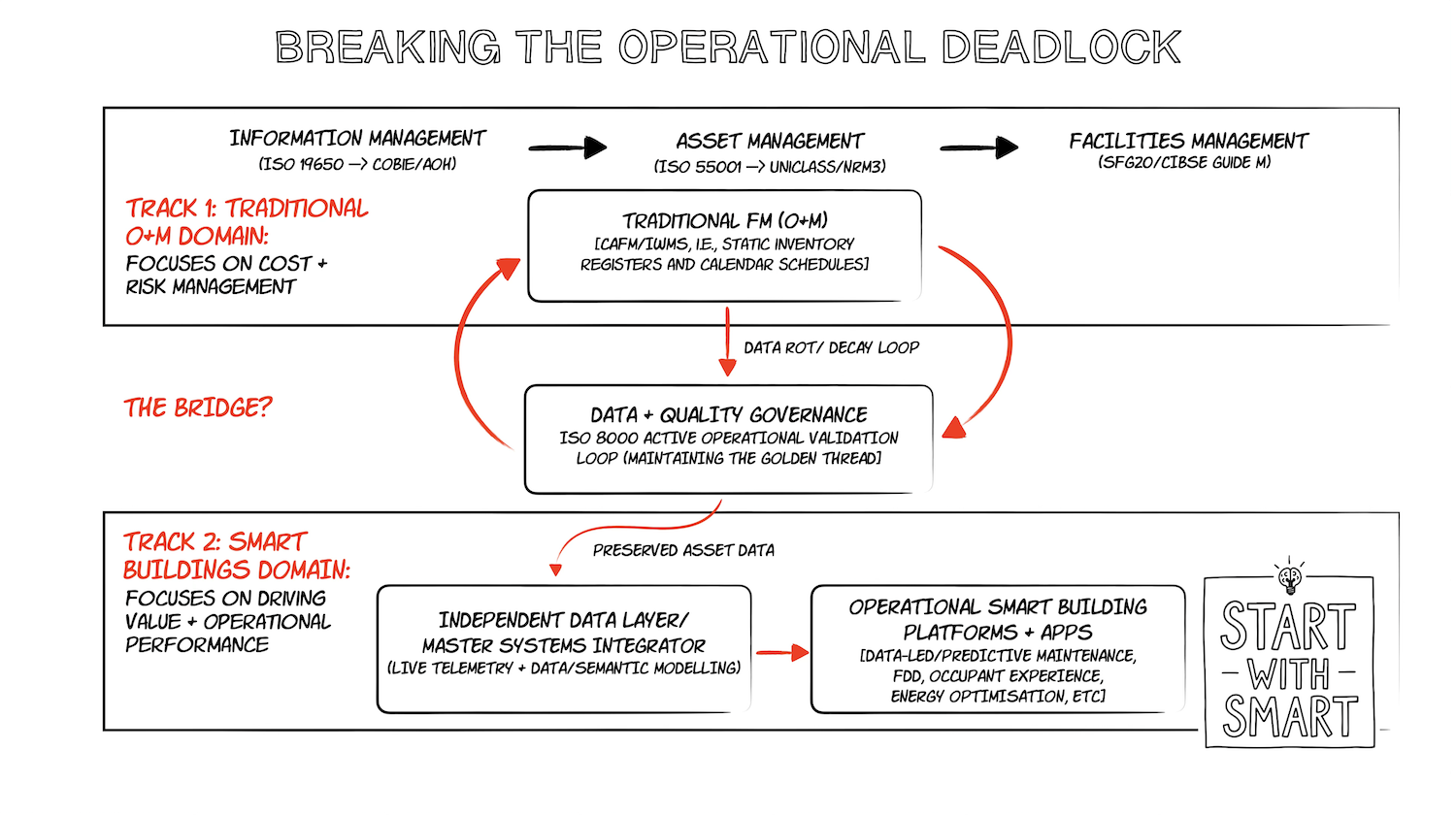
Traditional FM has historically been built around physical asset registers, planned preventative maintenance schedules, static compliance checking through SFG20, and long-term lifecycle costings, including capital renewal and replacement planning via NRM3. It is a domain focused on managing physical hardware and financial forecasting over time. For this specific purpose, static data packaging standards can provide a useful baseline for establishing basic inventory registers to feed traditional CAFM or IWMS platforms.
The smart buildings and smart FM domain represents a different discipline. This is a specialised integration and software domain driven by real-time telemetry, network protocols and software orchestration to provide the analytics and automation required for data-led maintenance.
Where traditional CAFM workflows are structured around static compliance checklists, smart FM operates on continuous, dynamic business performance goals such as optimising indoor environmental quality, reducing peak demand charges and driving automated carbon reductions.
Legacy frameworks often suggest that existing information management standards, such as ISO 19650 Part 3, already account for operational interventions. However, there remains a structural difference between logging a discrete maintenance event in a CAFM system and deploying technologies that provide continuous automation.
The core challenge is exploring how rigid, point-in-time project handover schemas can support live operations by effectively tying together static asset information with dynamic performance data. This is where semantic data modelling comes into focus. To develop an AI-ready building, the process requires moving beyond flat data packaging to define the contextual relationships and equipment data streams that allow automation platforms to function.
Recognising semantic modelling as a distinct requirement that works alongside traditional asset registries represents an essential step toward achieving a functional digital handshake. This is crucial if we are going to look at how the project-operations gap is plugged, rather than just how ISO 19650 meets its full lifecycle aims and ambitions.
To explore how these misaligned incentives can be addressed practically, we have to look at the role of performance metrics.
The closest the industry currently gets to an operational performance scorecard is something like the NABERS rating system. For this discussion, it is worth noting a distinct geographical variance in its application. In the UK, NABERS remains almost entirely confined to a narrow, single-vector focus on operational energy for office buildings. In contrast, its native Australian framework covers a much wider set of environmental, social and governance criteria, encompassing water, waste and indoor environmental quality.
I am not advocating for NABERS per se, nor am I promoting a specific scorecard. I bring it to the table purely to illustrate an operational capability that is currently lacking within the traditional information management space, which remains too process- and compliance-orientated to possess a framework for live asset performance.
This brings us back to the missing operational carrot. The real priorities of asset owners are driving operational performance, hitting genuine net-zero targets, and delivering improved occupant experiences. That is where the commercial value lies. However, information management has not yet shown how a static project delivery checklist can help unlock that value.
The real utility of an operational scorecard is how it can be used as a framework for thinking through the commercial contract to capture those priorities. If an operational performance target becomes a binding contractual obligation written into the initial project brief, it provides the real teeth required to plug the project-operations gap. It legally binds the design and delivery teams to the long-term, live operational outcomes of the building during occupancy.
This contractual leverage changes the entire nature of the handover. It ensures that the transition phase becomes a genuine, outcomes-focused soft launch for operations, rather than a traditional soft landings exercise designed merely to demonstrate delivery compliance and clear a contractual hurdle.
There is another essential area that has arisen from our Start With Smart group that does not appear to have been discussed across the wider industry, and it really does need to be addressed. The significance of this issue comes down to how the traditional information management community brings in the Building Safety Act and the golden thread to act as a regulatory stick to drive compliance on the operational side.
The core problem is that the information management community has no mechanism, either contractually or from a governance perspective, to prevent rapid data degradation once a building enters operation. The golden thread is not a static data package delivered at a single point in time at handover. It is a live, statutory obligation to maintain accurate asset information across a multi-decade lifecycle.
Aside from the heavy administrative burden this dumps downstream into operations, the reality is that the information management community is rarely involved in the 60-plus years of maintaining a building. The process is optimised for the delivery team who walk away at practical completion, leaving the asset owner without any active data quality governance mechanism to manage the data. Without enterprise data-quality frameworks, such as those found in mature IT domains like ISO 8000, the handed-over data begins to rot almost immediately.
The moment physical changes occur on site without a live validation loop to capture them, the digital record effectively becomes an inaccurate museum piece. This tracks back to the core issue of incentives and explains the friction on the ground. On the project side, the incentive for structured data is clear because it helps delivery teams satisfy contractual milestones and secure payment. On the operations side, the question of what is in it for the operator has been completely ignored.
This is precisely why I have brought a discussion about performance-related contracts to the table. If data requirements are explicitly linked to long-term performance obligations and the overarching business strategy, it changes the commercial reality for operators who are forced into continuous cost-cutting in the current race to the bottom. By aligning the data baseline with tangible corporate goals, the operator can clearly demonstrate that, while maintaining data integrity requires dedicated resources, it is a necessary investment to deliver verifiable business value rather than just an additional compliance cost.
Right now, the top-down regulatory stick falls down because you cannot maintain a legally compliant golden thread using a static project delivery mindset while the underlying data actively decays.
This brings us back to the initial premise of the entire discussion. I hope what has been made clear throughout this piece is that I am not bashing information management, nor am I dismissing the real progress made by standards like ISO 19650 in standardising project delivery. What I am offering here is a critical appraisal of scope and methodology. We must be honest about where a project delivery process standard ends and where enterprise asset governance, live software orchestration and data quality management must begin.
By outlining what has been emerging from the collective thinking within the Start With Smart group, the goal is to show where and how these structural issues can be resolved. That includes bringing the latest thinking, tools and best practice from our own digital operations community directly to the table.
Plugging the project-operations gap cannot happen inside a closed-loop echo chamber. Achieving a functional digital handshake requires bringing together voices from across the full asset lifecycle, right at the boundary where digital construction, smart buildings and digital operations meet. It also requires drawing on input from mature domains like banking and aerospace, which are structurally miles ahead in their digital transformation and data governance maturity.
Given that the built environment practically lags behind every other major economic discipline, looking outside our sector is the only way to establish what good actually looks like. Between the three pillars of smart buildings, digital construction and digital operations, we have a sizeable and highly capable group who can provide valuable, practical input to help bridge these gaps.
Ultimately, this is an open invitation to participate and collaborate. It will be interesting to hear the views on these structural deadlocks from those working across the sector. If there are other logical gaps or missing vectors that people feel have been overlooked here, or if there are more pressing challenges that need to be addressed first, it is essential to understand what they are so we can focus the industry dialogue on the areas of highest commercial value.
Keep up to date with DC+: sign up for the midweek newsletter.