Why alliance contracting needs digital discipline
15 September 2026

The majority of professionals use Uniclass, but too many other professionals don’t know which classification system their business uses. Phil Simpson from NBS explains why that gap in understanding undermines everything from BIM to whole-life carbon reporting, and what to check on projects.
Picture a handover that should take an afternoon and instead drags on for a fortnight. A design team passes its specification to the contractor, who sends product data to the manufacturer, who returns it to be checked against the model. Somewhere along that chain, two teams have classified the same structural element differently. That’s where the problems start. The codes don’t match, the data won’t line up, and information that was correct the first time round has to be re-keyed or rebuilt. This wastes time, erodes data quality and weakens the basis for everything that follows, from cost planning to asset management to carbon reporting.
We looked into why this keeps happening and found a notable awareness gap. In 2023, 18% of respondents to the NBS Digital Construction Report said they ‘didn’t know’ which classification system their organisation commonly used. In the 2025 report, just under 20% still said they were ‘not sure’.
Classification is the common language that enables digital construction to work at all. It sits beneath the model, the cost plan and the asset record, telling every system what an item actually is. Get it right, and a mass of documents becomes connected, usable data. Get it wrong, or don’t know what you’re using, and information has to be rebuilt at every handover.
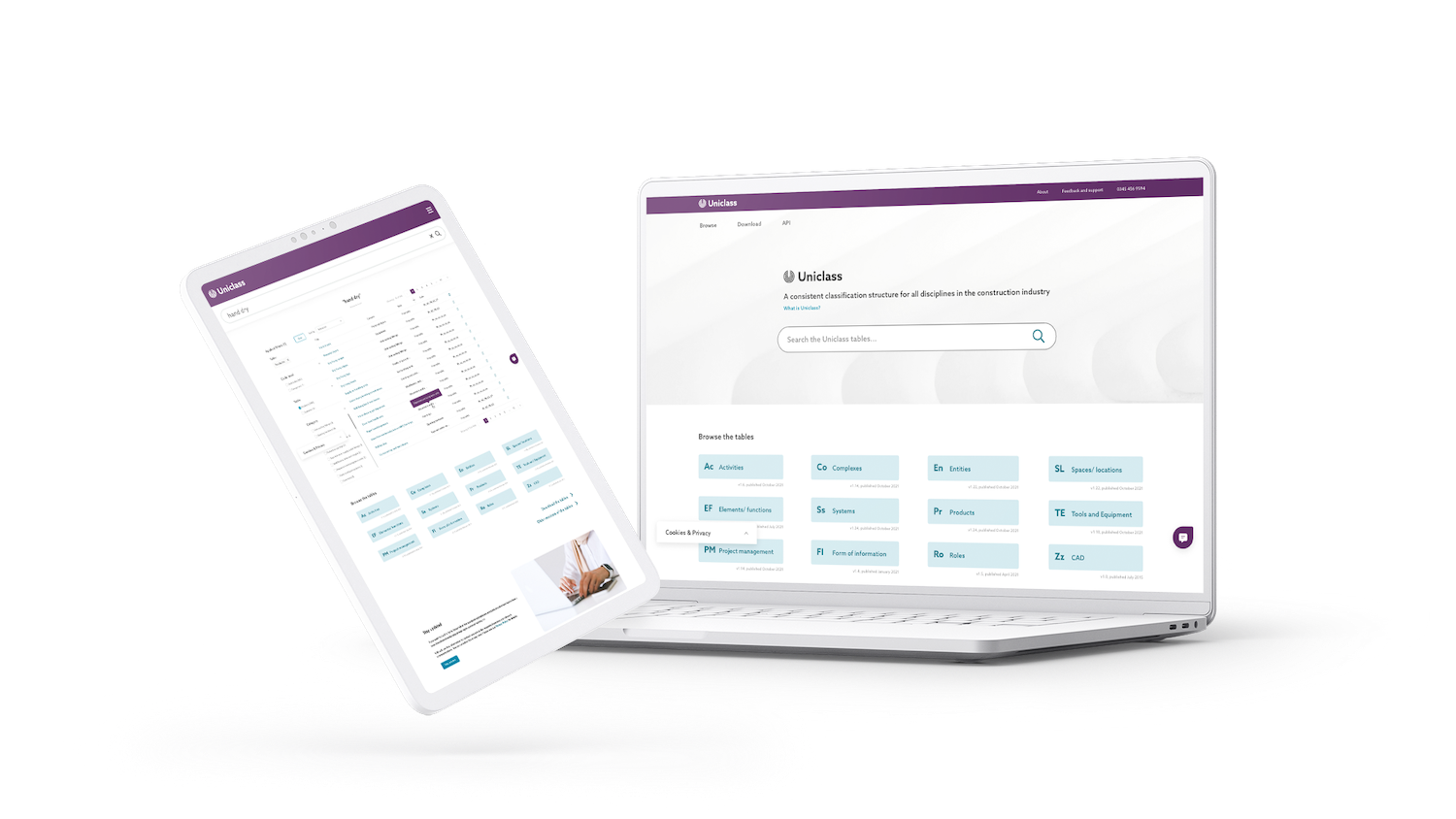
The reason a shared system is best for enabling digital construction, and an in-house set of codes falls short, comes down to how a system like Uniclass is built. It is a faceted system: the same physical thing is described from several angles at once, each in its own table. A rainwater pipe is a product; it belongs to a drainage system; that system serves a building entity; and someone installs and later maintains it, which is an activity carried out by a role.
Each of those has its own code, and the codes are designed to relate to one another. That is what lets a specification, a model and a cost plan describe the same object and reconcile without anyone re-keying the data. A bespoke code list can label things perfectly well within one organisation, but it carries no shared meaning across the project team, and it is at the handovers that the value appears.
“The golden thread of building information, which the Building Safety Act 2022 requires for higher-risk buildings, is far harder to maintain unless products and data are classified consistently from the outset.”
Among those who can name their system, Uniclass is dominant by some distance. In the 2025 NBS Digital Construction Report, Uniclass is the classification system used most by 59% of the professionals we surveyed, up from 46% in 2023. Those figures come from 559 professionals, two-thirds of them consultants, designers and specifiers, so they reflect the part of the industry closest to this work.
Set that against BIM adoption at 72% (and with nearly 88% either using it or planning to), and the shape of the problem is clear. We have an industry that has, by a large majority, gone ‘all in’ on digital, while a fifth still struggle to name the common language everything digital rests upon.
It’s also worth noting that Uniclass is not simply an in-house preference. It’s the classification recommended in the ISO 19650 series, the international standard for managing information across a project.
This is where the awareness gap goes from being an administrative footnote to a real risk. The golden thread of building information, which the Building Safety Act 2022 requires for higher-risk buildings, is far harder to maintain unless products and data are classified consistently from the outset.
The same approach applies to any credible attempt at whole-life carbon reporting. And it applies to digital product passports as they take shape: it’s an EU framework for now, but it’s also a clear signal of where product data requirements are heading. Each of the major trends now shaping our industry rests on the same basis: products and information all classified using the same common language.
Encouragingly, classification is evolving to keep pace with industry requirements. Uniclass is updated every quarter, and each release is shaped by what professionals say they need. The surface water management codes from early 2026 are a good example. There are seven of them, spread across the products, systems and spaces tables, and they came out of work with the Environment Agency, which uses Uniclass to classify its own assets.
The pace hasn’t let up since: the July 2026 update added 42 new classifications across four tables, from new vehicle and transport product codes to additional accessible spaces developed with the University of Liverpool.
Additions like these happen because people hit gaps on live projects and tell us about them. The system moves forward in response to real demand, which shows how central it has become.
Uniclass is free to download and use. Anyone can pick up the tables and start applying them. The barrier has never been about cost or access. It’s a question of awareness, and awareness is fixable.
To start making progress, here are three questions to put to your team this week:
If your team can answer all these queries positively, you’re in better shape than most. If not, you’ve just found the reason your data keeps needing to be rebuilt. And now you’ve likely also hit upon a cost-effective way to fix one problem this year.
The opportunity now is to close the awareness gap. The system is there, it’s evolving, and it underpins every other digital ambition the industry holds.
Find the Digital Construction Report 2025 here. The Uniclass tables are free to download from the NBS Uniclass tool.
Keep up to date with DC+: sign up for the midweek newsletter.