


Why alliance contracting needs digital discipline
15 September 2026

In the first of a two-part series, Justin Kirby tackles the structural clash between top-down enterprise architecture and bottom-up project delivery, explaining why commercial incentives currently keep the built environment trapped in a left-to-right mindset.
It is a little over two months since I facilitated several panel discussions at DCW, where my Start With Smart group was the official partner for the Digital Operations stage. This included facilitating the announcement of the strategic collaboration between the Digital Operations Working Group and nima on the Information Management Initiative.
Since then, I have been reflecting on how Start With Smart can best contribute to the collaboration’s effort in guiding the ISO 19650 standard toward its full-lifecycle ambitions.
On the one hand, there is the representation of the operational community itself, which extends far beyond the traditional BIM and project delivery domains. On the other, the collective thinking within our group has highlighted critical methodological conundrums that need to be addressed if we are ever going to plug the project-operations gap. That is what I plan to lay out here.
Perhaps the biggest conundrum of all is the methodological one.
To explore it properly, we have to look at where digital transformation actually starts when we step outside the built environment sandbox. According to the McKinsey Global Institute Industry Digitisation Index, the construction sector ranks second to last for overall digitisation rates, sitting just above agriculture and hunting. If we examine how more digitally mature domains approach enterprise architecture, we quickly uncover a core structural inversion. Mature corporate sectors use strategy-led, top-down design, while the built environment frequently suffers from tech-led, bottom-up fragmentation.
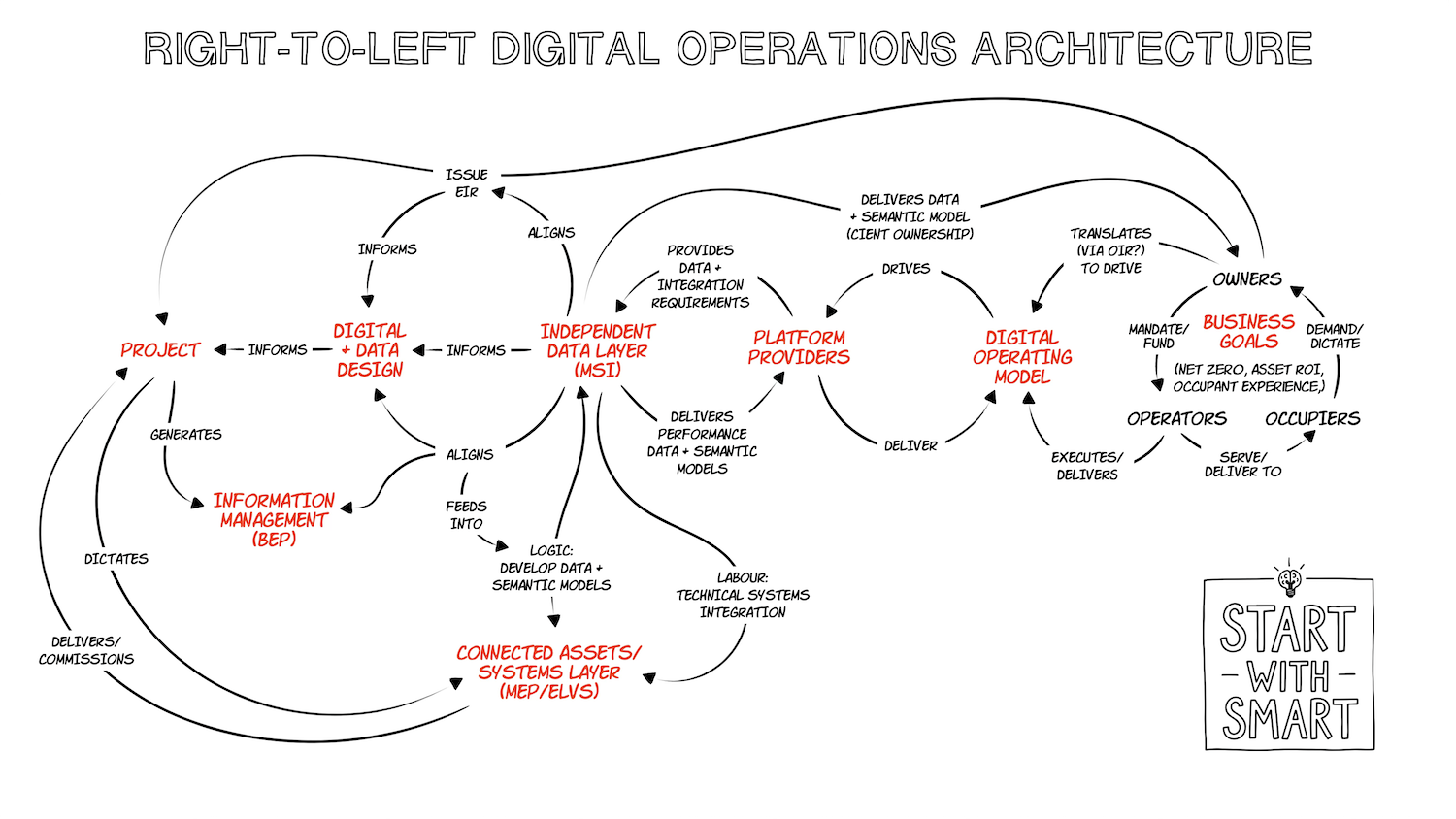
That is where we hit the fundamental split: the distinction between working right-to-left versus working left-to-right.
In mature corporate sectors, enterprise IT architects and management consultancies design transformation right-to-left. They start at the top with the core business strategy, which dictates the overarching digital strategy. That digital strategy then governs the top-down cascade through three distinct operational layers:
What is happening in the built environment, particularly within the information management and project delivery communities, appears to be the reverse of this entire trajectory. Put simply, they attempt to work left-to-right. They dive straight to the very bottom of the stack, grab a piece of technical file syntax or folder structure at the DOM layer, such as COBie or IFC, and expect an operational asset governance philosophy to somehow grow upward from a static folder rulebook.
The information management community will naturally point to ISO 19650 and argue that frameworks like Organisational Information Requirements and Asset Information Requirements exist to prevent this. In theory, they do. In practice, however, feedback from the operational side highlights a persistent structural gap. Information requirements are almost universally authored by project delivery teams or capital-side consultants whose involvement ends at practical completion.
Because these delivery teams do not manage the live day-to-day operations of the building, they are rarely positioned to define a corporate operating strategy from the top down.
As a result, the task often becomes a transactional project requirement to satisfy a stage gate. This leaves delivery teams with little choice but to work bottom-up, taking a technical file syntax at the DOM layer such as COBie or IFC and trying to stretch it upward to mimic a governance framework.
Crucially, this problem is two-sided. If we look at the Smart Buildings Overlay to the RIBA Plan of Work, the design and delivery community appears to conflate a smart building strategy with an enterprise-wide digital strategy, which also puts the cart before the horse.
In information management, the underlying friction comes down to the confusion created by the word standard. Technical process standards like ISO 19650 are fundamentally about syntax and data packaging rules. They are not asset management standards like ISO 55001, which serves as a genuine business governance framework for the long-term operational strategy, risk management and financial accountability of running the asset. Yet, the shared use of the term creates a misleading impression that satisfying a project-delivery information checklist is the same thing as executing a digitally transformed asset governance strategy.
You cannot solve a multi-decade operational performance challenge by treating bottom-up, left-to-right project delivery tools as a substitute for enterprise transformation. Discussing how to reconcile these two distinct trajectories, and understanding the limits of a process standard, is the essential first step for any constructive facilitation.
To dive a little deeper, let us look at how this plays out in practice.
To understand why this left-to-right approach remains so deeply entrenched, we have to look at how commercial incentives operate across different stages of an asset lifecycle.
On the capital project delivery side, structured information management succeeds because it operates with a clear balance of incentive and requirement. For tier 1 contractors and design teams, standardising data packaging is not an abstract corporate philosophy. Instead, it functions as an essential risk-mitigation tool. It provides a recognised framework to satisfy contractual requirements, manage delivery liabilities, secure practical completion, and get paid. On the project delivery side, the commercial logic is straightforward.
When we cross over to the long-term operational phase, however, that commercial equation becomes far more opaque.
It is not clear how the information management community has demonstrated to asset owners where the direct return on investment lies, particularly regarding how structured data acts as an enterprise performance tool to drive their corporate priorities. Without that clear business case, it defaults to a grudge compliance cost. One can easily see why many operators feel they are simply being handed an additional administrative burden under the banner of legal and regulatory compliance, while the project delivery team walks away with their risk shield intact.
Indeed, one could argue that parts of the AEC sector are inadvertently trying to pass off a project-side risk shield as an operational strategy. While a standardised handover file helps a project team clear its contractual hurdles, it leaves the operator with a static data envelope that may offer very little proactive utility for running a complex building day-to-day.
For example, autonomous AI platforms are being deployed today that help operators deliver 45% to 50% energy drops across massive portfolios of more than 6,000 properties simply by plugging directly into live telemetry. When you speak to these operators, they achieve those outcomes by executing real-time Advanced Supervisory Control without needing to use or even know what terms like COBie or IFC mean. As long as information management processes are optimised primarily to satisfy project-side compliance, it remains difficult to see how they can deliver genuine, long-term operational value.
Part 2 of this feature will be published on Thursday 20 August. In it, Kirby moves from diagnosing this structural deadlock to examining the frontline operational reality. He’ll explore the disconnect between static legacy CAFM and dynamic smart FM, explain why static handover data decays without active governance, and details how performance-related contracts can give the digital handshake real commercial teeth.
Keep up to date with DC+: sign up for the midweek newsletter.