



Autism in construction: achieving – yet hiding – in plain sight
2 April 2026

The Digital Operations Working Group (DOWG) has been established to move the industry beyond discussion and into direct action, bridging the gap between project delivery, non-technology digital requirements and long-term estate management. Led by Steven Boyd MBE and Gordon Mitchell, the group applies ‘right-to-left’ thinking – starting with desired business outcomes – to create a ‘digital handshake’ that connects capital delivery with operations. Justin Kirby outlines how the group is connecting existing standards and frameworks to develop a digital operations playbook that supports the entire building lifecycle.
Last year, the two articles I contributed to DC+ that explored the plugging of the project-operations gap found significant traction, ranking among the Top 10 most-read and being selected as one of the editor’s picks. The Start With Smart group has clearly identified a strong appetite among stakeholders across the built environment lifecycle to share their pains, gains and jobs-to-be-done to address this structural challenge.
But to truly bridge the gap, it became clear that a shift from discussion to action to evidence-based outcomes was necessary. That realisation was the catalyst for forming the DOWG. For asset owners, operators and policy leaders, the project-operations gap consistently manifests as poor handover, unusable data and operational risks that persist for decades after a project completes.
The group is led by Steven Boyd MBE and Gordon Mitchell, who together represent the leading edge of policy, standards and relevant frameworks in this space. My role is to help establish and facilitate this initiative, moving beyond theory and starting with the digital handshake required to connect capital delivery with long-term estate management.
Many people view the operational phase as a cost centre focused on compliance, continuity and cost. We believe this perspective is a root cause of long-term value loss across the built environment. Operations typically account for more than 70% of whole-life costs, but, more importantly, it is at this lifecycle phase where safety, performance, carbon, resilience and user experience are either realised or eroded.

“We have to flip the logic. ‘Right-to-left’ isn’t just a phrase; it’s a methodology. It means starting with the operational requirement – the end state – and working backwards from there to define what the project team actually needs to deliver. If we don’t begin with how the building will be managed, we’ve failed before we’ve even broken ground.”
We firmly believe that no single standard or way of working covers everything digital operations stakeholders require. However, if integrated effectively, existing guidance can meet most needs, and any remaining gaps can be identified.
We are not seeking to develop new standards. Our aim is to join the dots between existing standards, data classifications and industry best practice to provide high-level guidance that charts a pragmatic and practical approach that all stakeholders can support.
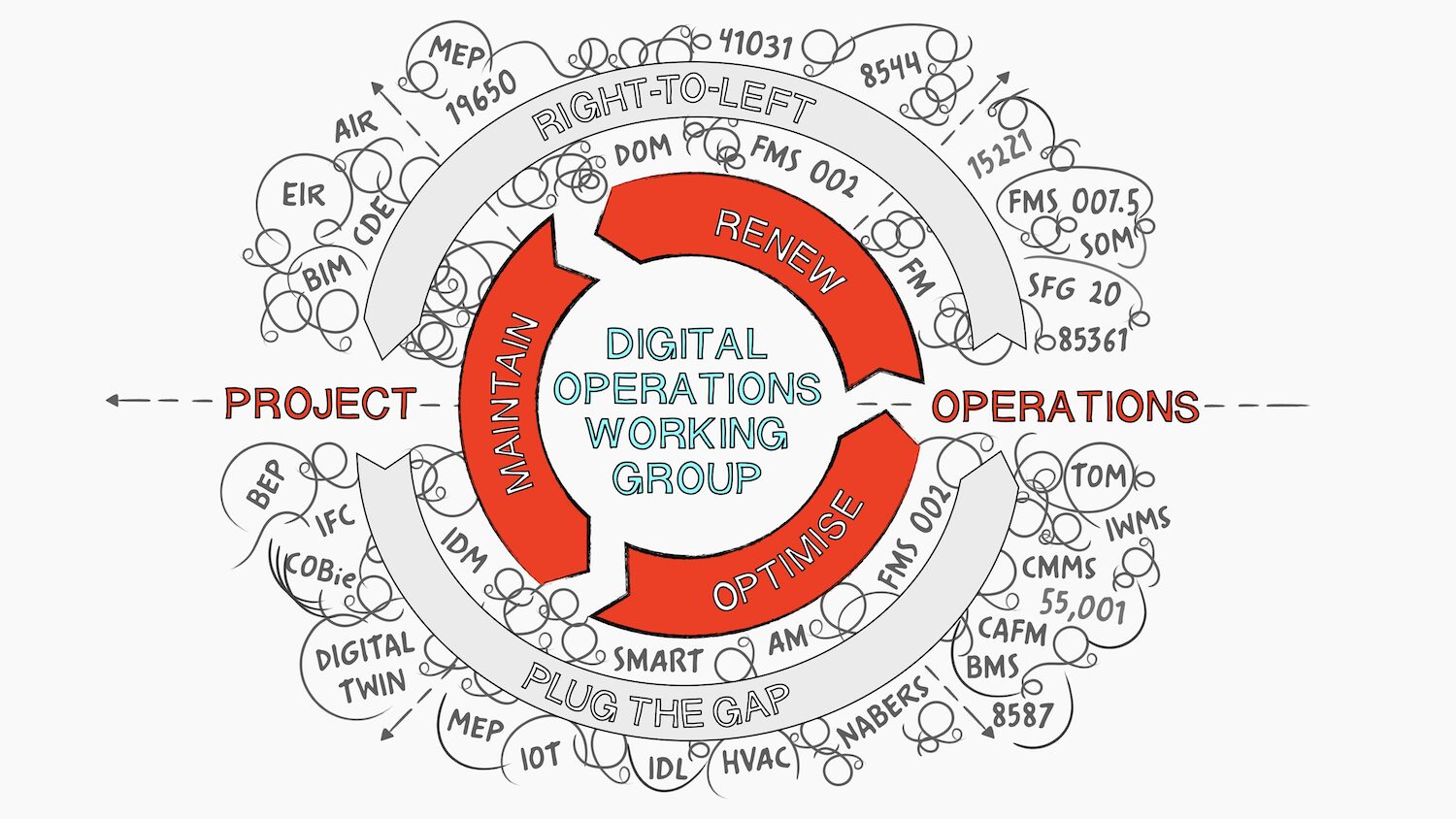
This requires a deliberate shift to right-to-left design: starting with the decisions, requirements and outcomes needed to operate, then working back to define what information, assurance and capability must be delivered through handover, construction and design to enable an effective whole-life approach.
We recognise the widespread use of the RIBA Plan of Work, but believe that more than one stage is needed to represent the longest period of a building’s life. We will explore how best to disaggregate Stage 7 in use so that we can work back to Stage 6 handover and into construction and design, and recognise the iterative nature of maintain, optimise and renew within Stage 7.
Our approach is to identify the decisions that must be made in the operations phase to deliver business outcomes, and the jobs that need to be done to achieve them. We will then define the minimum datasets required to enable these use cases.
We will work with senior stakeholders to co-create a simple, common language and a standard approach to structured asset data that can work across current silos and can be used equally for asset management, facilities management, smart buildings and project handover.
In collaboration with asset owners and their key suppliers, we will explore how these tools can be used to inform commissioning, project handover and soft landings, enabling effective data transfer from projects into operations.

“The industry might need more frameworks and standards; however, we can build up momentum right now by understanding the ones we already have and how they can practically be applied and actually.”
We recognise that there is a wide range of digital maturity across stakeholders. To address this, we intend our guidance to be equally suited to the most advanced and those just starting out, ensuring that the model can adapt to support different levels of maturity and continuous improvement.
The primary output of the DOWG is the Digital Operations Playbook. This document will provide the strategic guidance required for planning and estate management, facilitating a vital shift from project-based silos to whole-life thinking centred on the operational phase. While our initial focus is on the public sector, the frameworks we are developing have clear crossover into commercial real estate, where similar operational inefficiencies exist.
To achieve this, we are working directly with strategic and technical leads to co-create the playbook. Our first task is to map the landscape – identifying and aligning relevant standards, initiatives and policies to demonstrate how the dots join up. This process will also highlight where gaps exist – such as in smart handover and digital soft landings – and where we can add immediate value by establishing a common language for the industry.
This mapping will lead into a series of industry roundtables designed to flesh out the playbook’s scope and explore key areas in more detail. These sessions will bring together high-calibre participants to ensure the output is grounded in real-world expertise. The culmination of this initial sprint will be at Digital Construction Week in June. As the official partner for the Digital Operations stage, the Start With Smart group will provide the platform to facilitate these important discussions and share the playbook’s progress with the wider industry. We look forward to collaborating with colleagues across the industry as we shape the future of digital operations.
Steven Boyd MBE
Boyd is an experienced senior executive and board-level leader in the built environment and infrastructure sector. Following a distinguished career in the British Army – including serving as the client for the Army’s worldwide estate – and as CEO of the Government Property Agency, he now holds several non-executive and strategic advisory roles. He is at the forefront of shaping estates and asset management policy standards for the public sector. A leading advocate for the effective use of data, he is currently collaborating with professional institutions to align data classifications and drive sector productivity through the DOWG.
Gordon Mitchell
Mitchell is the co-founder of Wholus and a leading expert in closing the data fracture between building design, construction and operations. As the ISO Global Standards Convenor for WG6 TC 267 and chair of the IWFM Technology special interest group, he leads international efforts across 54 countries to translate complex digital capabilities and ESG frameworks into adoptable operational models. Specialising in transforming digital clutter into organisational value and trusted insight, he focuses on the anthropology of change – ensuring that AI, digital twins and information management practices are successfully embedded with digital operations to deliver measurable ROI and sustainable, human-centred results throughout the building lifecycle.
Justin Kirby
Kirby is the founder of the Start With Smart group and a leading industry facilitator focused on bridging the gap between building delivery and operations. Currently a committee member of the Independent Digital Group governance committee for the New Hospital Programme and previously executive director of the Digital Buildings Council, he was recently a judge at the Digital Construction Awards and named one of DC+’s Digital Construction Power Players 2025. He brings a unique strategic energy to the DOWG, using his expertise in stakeholder engagement to turn complex industry challenges into clear, actionable conversations.
Keep up to date with DC+: sign up for the midweek newsletter.