



It’s chilly and wet now, but the heat will return. Here’s how tech can help
20 October 2026

New international research reveals that the construction sector’s current information landscape is not fit to support emerging sustainability policy.

The construction sector is entering a new era of mandatory sustainability reporting. Across Europe, regulations such as the Corporate Sustainability Reporting Directive (CSRD) and the Energy Performance of Buildings Directive (EPBD) are raising expectations on how organisations measure and disclose environmental performance. For an industry responsible for around 40% of global resource use, this shift is both necessary and overdue.
But there is a growing sense across the sector that something is not quite adding up. While the ambition is clear and justified, the practical question remains: can the industry realistically deliver what policy is asking for? Our latest research, published in the Environmental Science and Policy journal, suggests that, at present, there is a widening gap between policy ambition and the realities of project and asset delivery – and reminds us that this gap is systemic, not merely technical.
For many practitioners, the symptoms are already familiar. Project and asset data is scattered across spreadsheets, pdfs and disconnected platforms. Information is inconsistent, incomplete and often difficult to access when needed. For this reason, even relatively straightforward lifecycle calculations can require significant manual effort and constitute merely a snapshot in time, requiring labour-intensive and error-prone rework when inevitable changes occur.
At the same time, reporting expectations are becoming increasingly demanding, requiring organisations to track and predict environmental impacts across entire asset lifecycles in a transparent and auditable way. The result is a growing mismatch between what is legally required and what is currently achievable in practice.
A common response to the sustainability reporting challenge is the call for better data. More comprehensive datasets, more detailed reporting and more advanced digital tools are often presented as the solution. However, the findings of this research suggest that this conclusion is at best incomplete and, potentially, misleading.
More data does not automatically lead to better outcomes and in many cases, increasing reporting requirements simply adds administrative burden without improving decision-making. For some organisations, particularly SMEs, the effort required to gather and manage data risks becoming a barrier in itself. In others, it can encourage “checkbox compliance” rather than meaningful performance improvement.
What matters is not the volume of data, but its usefulness. The concept of data sufficiency is key, which means having enough of the right data, in a usable form. Without due consideration of data sufficiency principles, expanding reporting requirements risks gaming by organisations, non-compliance, or may even result in rollback on would-be progressive environmental policies, as we’ve seen with the recent watering down of CSRD through the Omnibus.
Upon closer inspection, the issue is not simply about how much data is available, but how it is structured and shared. Our current digital landscape is dominated by proprietary systems that do not easily communicate with one another, often by design. Data is typically locked within closed software environments, making it difficult to transfer, integrate or reuse over time. For assets with lifespans measured in decades, this creates a fundamental mismatch.
Practitioners experience this as a constant cycle of obsolescence, system changes and data migration, often losing valuable information in the process. It is not unusual for organisations to spend years transitioning between platforms, only to face similar challenges again a few years later.
One practitioner interviewed during the research put it bluntly: “It takes between three to four years to switch provider, and even so, there’ll be one consultant from the old service running around because of some legacy crap in there. You can’t do this [envisaged policy landscape] without open data.”
Perhaps the core message from the research is that this challenge cannot be solved through technology alone. The study illustrates the fact that while digital tools are part of the solution, they sit within a wider system shaped by policy, commercial incentives and organisational behaviour. Treating sustainability reporting as a purely technical problem risks ignoring other systemic factors that ultimately determine whether it will succeed.
If regulation demands detailed reporting without considering implementation cost, it risks excluding smaller firms. If commercial incentives prioritise short-termism and a lack of investment in process, long-term data quality will suffer. And if software markets continue to favour closed ecosystems, interoperability will remain limited regardless of technical capability, and customers will suffer. This is, fundamentally, a system design problem.
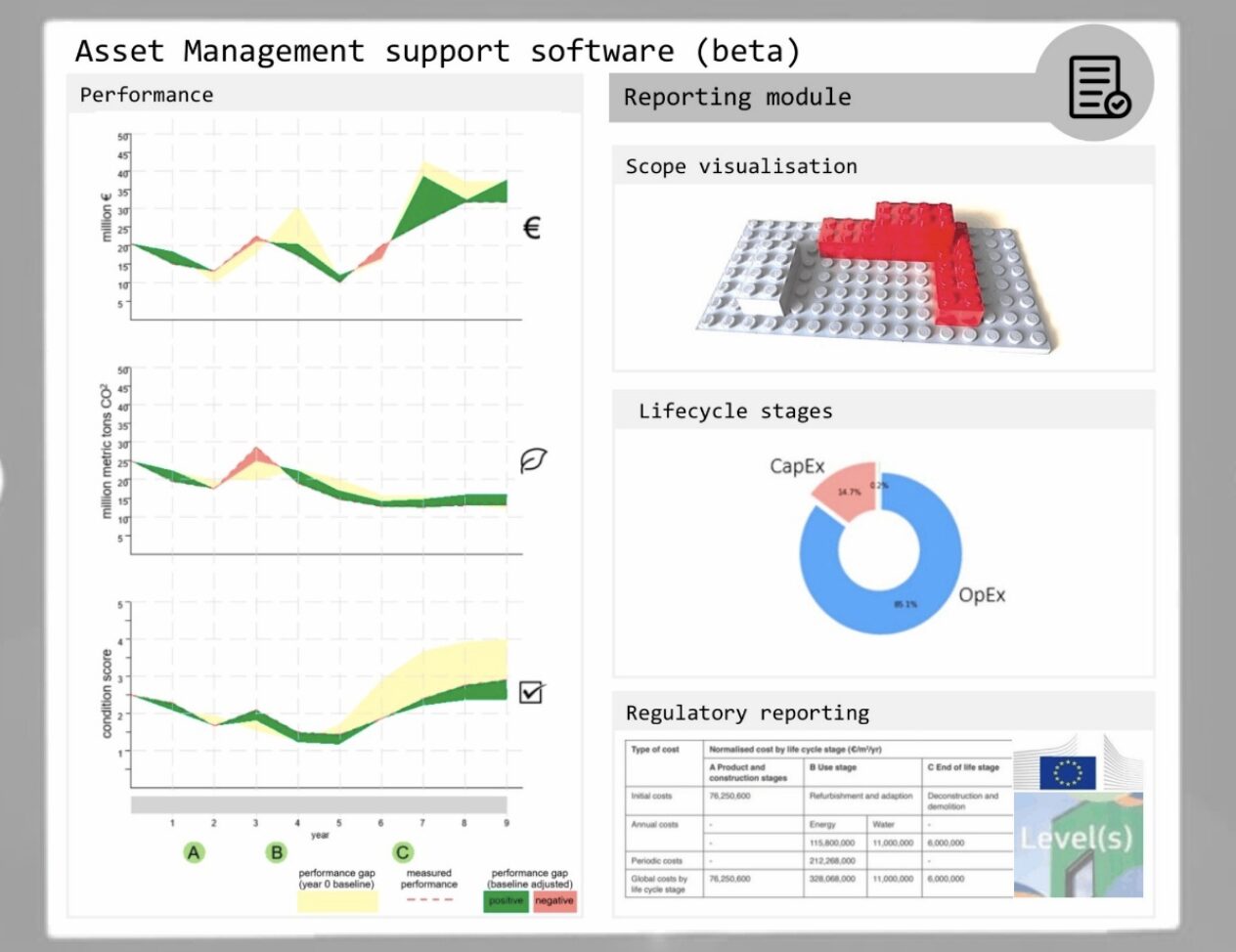
The research suggests that many of these challenges are not coincidental, but a result of current market logic. Construction and asset management remain largely structured around short-term delivery horizons, while sustainability policy increasingly demands long-term, lifecycle thinking.
In this context, incentives can be misaligned. Traditional procurement and contracting models tend to prioritise the lowest upfront cost and short-term performance, with limited accountability for long-term outcomes. This sits uneasily alongside policy ambitions that attempt to determine asset value based on whole-life performance.
The study points to a need for a shift towards more performance-based approaches to procurement and asset management, where outcomes over time are the basis for decision-making and accountability. Without changes to how projects are procured and delivered, the industry will struggle to support the lifecycle agenda on which these emerging sustainability policies depend.
This places a significant responsibility on policymakers – not just to set targets, but to ensure that they are achievable in practice. This research stresses the need for more active state involvement in shaping the information landscape. This includes providing clearer guidance, supporting standards harmonisation across regions, and investing in shared data infrastructure that reduces duplication and uncertainty for practitioners.
There is also an important role for the public sector to lead by example, demonstrating robust data practices and more holistic procurement models within publicly funded projects.
At the same time, policy must remain grounded and based on what one interviewee described as the “imperfect data reality”. Overly complex and idealised data requirements risk increasing administrative burden without improving outcomes, and may carry unintended consequences, including favouring larger organisations at the expense of SMEs.
Ultimately, the challenge is not just technical, but organisational. Sustainability targets often sit at the strategic level, while project and asset decisions are made elsewhere, with often limited connection between the two. Bridging the gap between ambition (C-suite) and execution (operations) will be critical if sustainability initiatives are to move beyond reporting and meaningfully shape how the built environment is delivered and managed.
The construction sector is not short on sustainability ambition. This is reflected in recent high-level political initiatives such as the Buildings Breakthrough at COP26, and recognition in the Intergovernmental Panel on Climate Change’s (IPCC) Sixth Assessment Report as a key sector for mitigation. What is missing is the information backbone needed to support this ambition.
Without addressing how data is structured, shared and governed, and without aligning policy, technology and market incentives, there is a real risk that ambition will outpace delivery.
For practitioners, this is not an abstract concern. It will shape how projects are delivered, how assets are managed and how organisations compete in an increasingly regulated environment. Better data will play a role. But on its own, it will not be enough. There are bigger systemic challenges at play, ones that are articulated in this latest research.
Conor Shaw is a post-doctoral researcher in LUT University’s Sustainability Science group, which interrogates the complex issues related to sustainability within and beyond the built environment.
Keep up to date with DC+: sign up for the midweek newsletter.