


Autodesk boosts civils functionality
15 September 2026

Want to capture site reporting as it happens that not only de-risks your operation, but also improves your records when dealing with a dispute? Scopey Onsite could be the solution you’re looking for.
Ahead of appearing at Digital Construction Week in the Start-Up Village, Scopey Onsite director Jenna Farrell tells DC+ about her startup.
Jenna Farrell: In construction, getting the work done is not always enough. The quality of the records tied to that work can make or break a contractor’s commercial position.
Construction contracts contain strict requirements for documenting and notifying site events that may impact time, cost or delivery. Missing a notice deadline or poorly documenting an issue can quickly escalate into tens or hundreds of thousands of pounds in unrecoverable costs.
Yet poor, inconsistent or late documentation is often a natural consequence of the pressure that site teams are under to keep projects moving. Their focus is on delivery, coordination and problem-solving on the ground. Under that pressure, teams naturally default to the fastest and most efficient forms of communication available, including messaging apps and informal conversations.
Most construction systems still rely heavily on people manually translating those fragmented conversations into structured records later, often through time-consuming workflows that were designed around ideal reporting processes rather than the realities of delivering work on live construction sites. The expectation is usually that teams will enter better information, despite the operational pressures they are already managing throughout the day.
By the time records are formalised, critical context is often missing, inconsistent or difficult to substantiate. Scopey was developed to close that gap between site activity and commercial control.
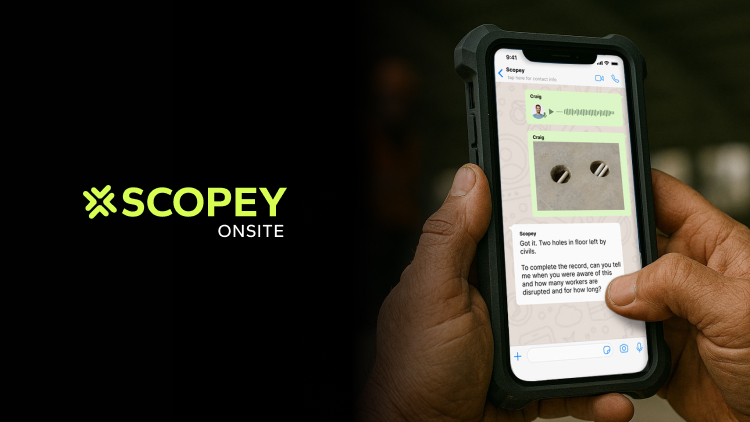
The platform captures site communication and turns it into structured commercial records. Teams can submit updates conversationally using short messages, photos or voice notes, while the system prompts for commercially relevant information specific to the scenario being reported. That includes timing, impact, cause, responsibility and other details that may later become critical if the event is challenged or reviewed.
Scopey helps companies create commercially robust and defensible records without relying on site teams to think like contract administrators or dispute specialists while they are trying to deliver a project.
Consistency is also a major issue across construction. Workforces are transient, teams change constantly between projects, and reporting quality varies significantly between individuals. Scopey helps standardise how commercially important events are captured so that project records are more complete, traceable and capable of withstanding scrutiny later.
Scopey is currently being deployed across active projects in Ireland and Australia, covering commercial construction, infrastructure, utilities and industrial works.
The platform has been tested across multiple forms of contract and in environments where documentation quality and contractual timelines are commercially critical.
One of the strongest early results has been the improvement in the quality and completeness of project records once teams are guided through the right commercial context during capture.
Rather than expecting site teams to understand every contractual implication of an event, Scopey prompts for the types of details that commercial teams, QSs and dispute specialists typically need later. That includes information on impact, timing, sequence of events, responsibility and supporting evidence.
In one early deployment, a contractor captured roughly 75% more project information than they would typically record through their existing reporting processes. Over several weeks, 70 site events were captured through the platform, which translated into 20 contract-related notices requiring commercial review under the terms of that project’s contract.
An added benefit of commercial teams gaining access to more contemporaneous and traceable records linked directly to project activity is that risks can be identified and acted on much earlier. That earlier visibility gives contractors more opportunity to respond to issues, mitigate commercial exposure and ideally resolve problems before they escalate into formal claims or disputes.
Scopey’s leadership team combines experience across regulated systems, SaaS, operational delivery, workflow design and construction commercial processes.
Collectively, the team has significant experience designing and building complex digital systems where user experience, workflow structure, auditability, compliance and data integrity are critical requirements. That background heavily influenced how Scopey approaches construction workflows, particularly the focus on designing around how people naturally communicate and operate under pressure on live projects.
A major differentiator for Scopey is the involvement of chartered QS and construction claims specialist Mark Kehoe at board adviser level.
His experience spans construction law, dispute resolution, mediation and evidentiary review across hundreds of construction disputes. Throughout his career, he has seen firsthand how claims are challenged, how records are scrutinised and how commercially valid positions can fail.
One of the most common issues across construction is that companies may have a legitimate entitlement, but they miss a contractual notice deadline. Once that happens, the strength of the underlying claim often becomes secondary to whether the contractual process was followed correctly.
This experience is embedded into how Scopey structures records, prompts for commercially relevant information and identifies contractual risk throughout the life of a project.
In many cases, the level of expertise required to properly assess these risks only becomes involved once companies are already deep into formal disputes, adjudication or litigation. Scopey is designed to embed that level of commercial and evidentiary thinking into day-to-day project workflows.
D170j.
Keep up to date with DC+: sign up for the midweek newsletter.