


Arup’s scaffolding, giant Lego and DeWalt’s data centre robot make TIME’s top innovations list
21 October 2026

Most architecture firms are now using AI but their designs aren’t any better and future talent needs to be protected.
The Royal Institute of British Architects (RIBA) AI Report 2026 found that 74% of architecture practices are using AI, up from 59% in 2025. However, just 17% felt their designs were better due to AI.
Practices appear to be using AI to boost productivity and efficiency, but human judgement, creativity and critical thinking are still seen as key to high-quality design.
However, the report raised issues around future talent as 61% felt it will become more difficult for early career professionals as AI automates tasks traditionally used to obtain essential skills and experience.
While there is no clear evidence yet that AI is impacting jobs, some 59% of practices felt AI will lead to staff reductions across the profession.
The report also raised ethical and environmental questions around the use of AI and, crucially, who is in the driving seat as knowledge bases used are hidden. The built environment is already battling to reduce its high environmental impact, and AI has the potential to both mitigate and add to that impact.
RIBA president, Chris Williamson, said: “Organisations are increasingly implementing AI in day-to-day operations, and architects, like many other professionals, are already seeing benefits in productivity and efficiency.
“On the other hand, this research makes it clear that the profession does not see AI as a replacement for human creativity and judgement, which remains at the core of architecture. Professional oversight of design remains essential if tomorrow’s buildings are going to be safe and sustainable.
“The research suggests AI adoption is likely to have its greatest (and potentially most detrimental) impact on entry-level and early-career roles. If that proves to be the case, what are the long-term implications for the profession?
“If fewer people have the opportunity to develop foundational skills through early-career experience, how will practices support the next generation of architects?”
This links to another concern raised by the report, which is an overreliance on automated systems. This can create homogenisation of design, and amplification and deepening of existing biases. But it also increases the risk of bad design and a bad built environment.
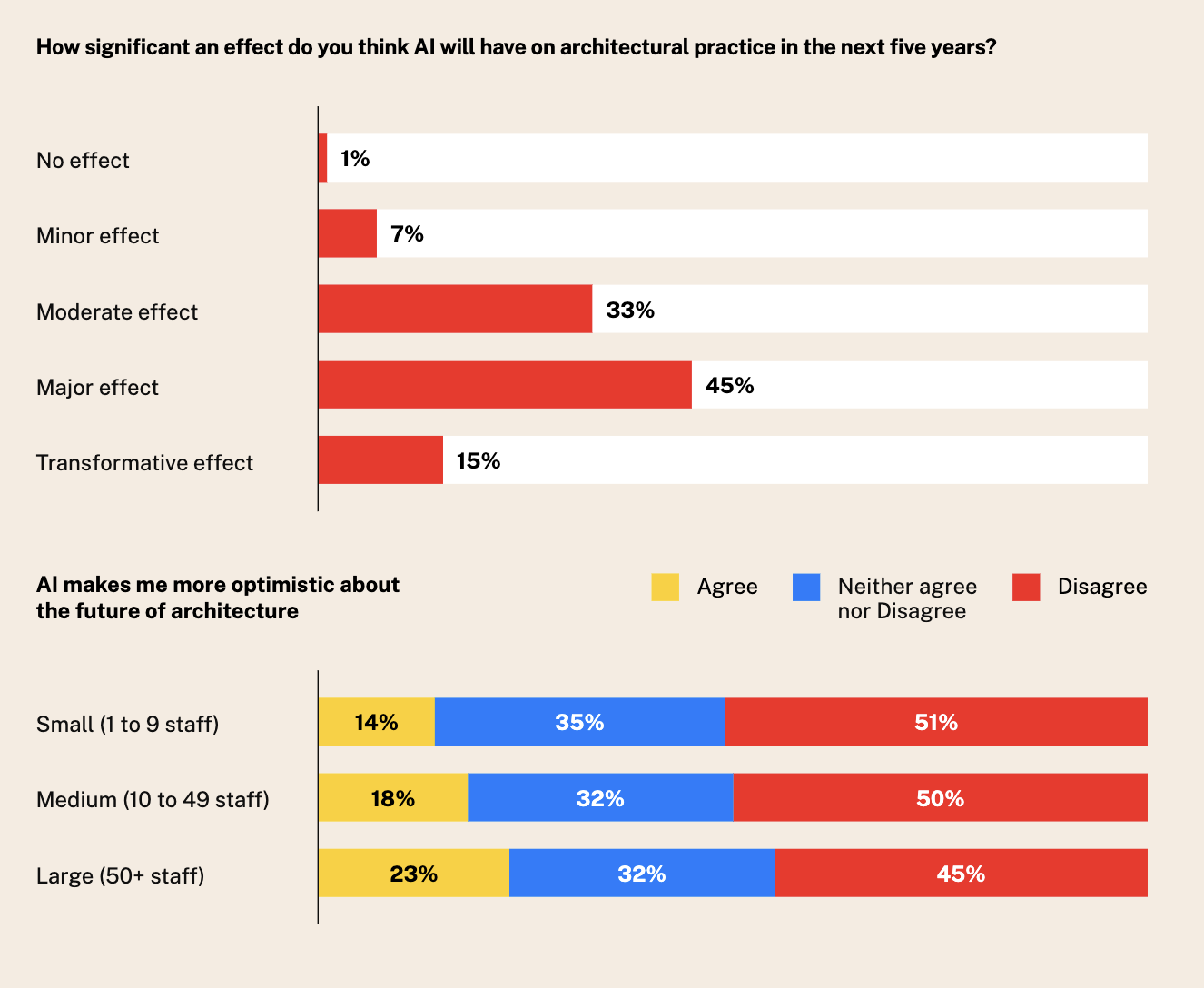
AI can produce designs that look polished, but without human qualification and experience behind it, the real-world consequences of bad design are huge.
In his foreword to the report, Williamson referenced qualities of professionalism, including principles such as life-long learning, ethics, education and responsibility. This backs RIBA’s campaign to modernise the profession to a competency-led approach.
Picking up the issue of environment, bias and the potential barrier to future talent, Katie Fisher, founder of CARD Projects, writes in the report: “If we uncritically adopt AI systems designed elsewhere, with values that we didn’t choose, we risk outsourcing our ethical responsibility as a profession. The question is not whether AI will shape architecture. It is already doing so.
“The real question is whether we will shape AI in return – in ways that centre justice, care, environmental responsibility and genuinely collective futures – or whether we will allow ‘progress’ to mean faster extraction, narrower access and deeper inequalities. Who is AI being designed for? If the answer remains ‘not everyone’, then we have work to do.”
Keep up to date with DC+: sign up for the midweek newsletter.