


Understanding BAM’s digital approach
10 March 2026

What have Coldplay, Shaun The Sheep, David Hockney and Laing O’Rourke got in common? By the end of this year, they will all have headlined exhibition and performance spaces at Aviva Studios in Manchester. The first three on that list make sense, but what about Laing O’Rourke?
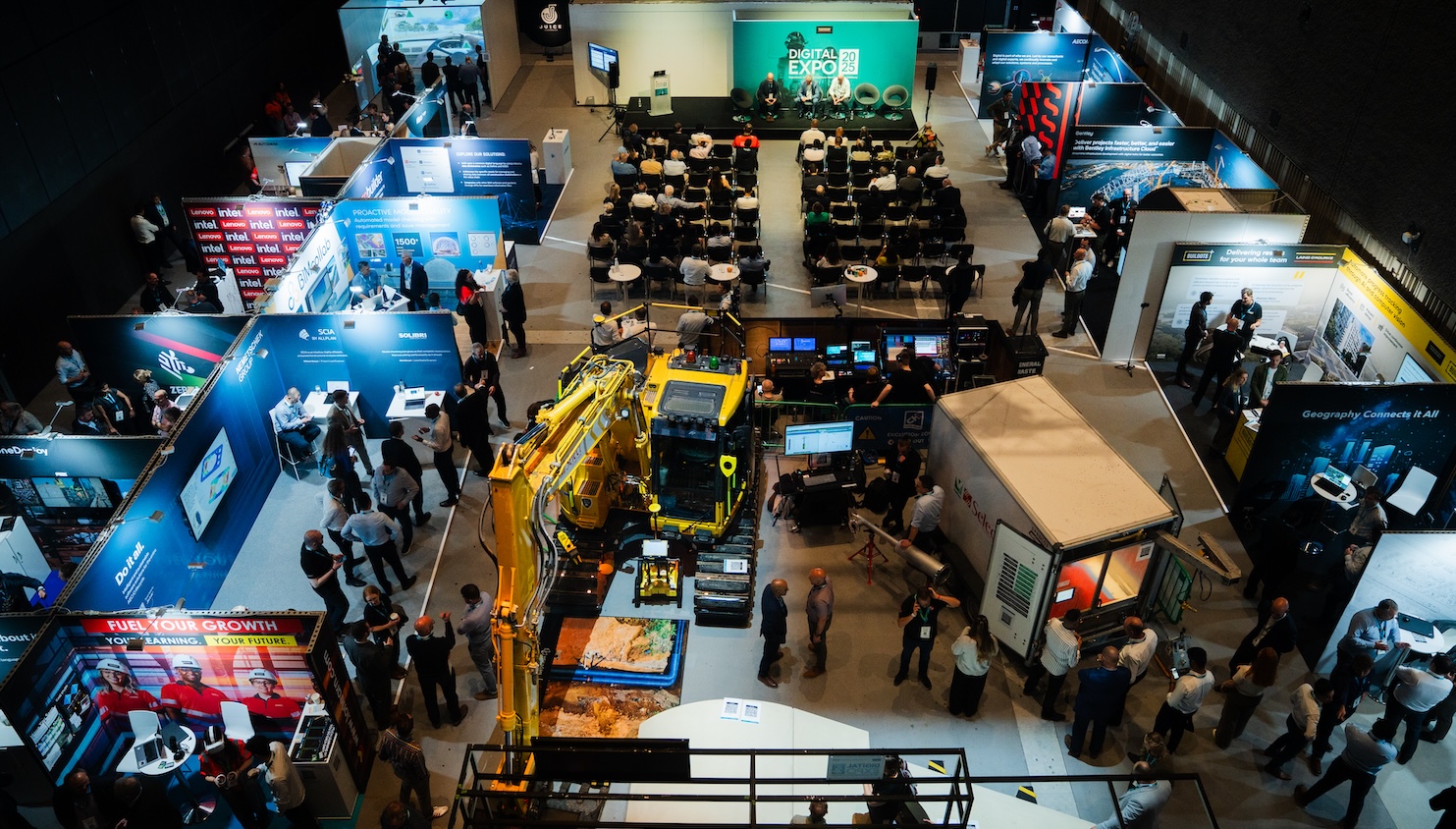
Having built and handed over the Aviva Studios venue to client Factory International in 2023, the contractor returned to the site as the main attraction for one day in September, staging its Digital Expo. The event, for 400 people (the contractor’s staff, clients, and its digital supply chain – plus this journalist), was a mini-exhibition/conference. It was conceived by Paul Drayton, head of digital – Europe at Laing O’Rourke, and delivered by members of his team. His team has run conferences every six months for themselves in order to drive collaboration, but never taken on a task as challenging as delivering an expo before.
There are more than 200 people in Laing O’Rourke’s digital team – that includes digital engineers, information managers, those involved in broader digital adoption and developments, plus those working for the contractor’s specialist arms such as Select Plant Hire and Expanded.
“We take digital seriously – you can’t do it off the side of your desk,” Drayton tells DC+. “We’ve got 30 live projects, all in different phases, and it’s impossible for everyone to know everything that everyone’s doing. How do we make the very best of what’s possible accessible to every project? Part of it is having a forum of project leaders sharing and learning from each other. If we can do it on one project in Laing O’Rourke, we can do it on every project in Laing O’Rourke.” Hence the idea of the expo: show staff outside of the digital team what technologies and processes they could be using and what the benefits are.
On stage, there were case studies of technology in action on specific Laing O’Rourke projects and panel discussions with suppliers and clients. Guest speakers were drawn from the likes of Heathrow, the University of Oxford, EDF, Everton, the University of Exeter, National Grid, Rolls Royce SMR and the New University Hospital Monklands. Among the 20-plus exhibitors were the likes of Aecom, Autodesk, BDP, Bentley Systems, Glider, Leica Geosystems and WSP.
The opening panel session sets the tone for the day when Darren Suttle, the project leader who oversaw the delivery of Aviva Studios, notes: “The first time I ‘stood in this room’ was in 2016 standing in an office in Blackfriars wearing 3D glasses from Buro Happold, reviewing all the different parts of the building. We wouldn’t have been able to build this building without doing it digitally. When you look at the digital build and you compare that with the time lapse of what of what we did, they are incredibly similar.”
“Architects like to design. Engineers like to design. We often treat projects as one-offs, but now we have an opportunity to standardise the invisible and customise the visible.”
Between panel sessions, DC+ tours the expo with Drayton as guide. He’s a passionate advocate for digital and it seems like he’s been practising digital construction all his career, even though he only joined the construction industry three years ago when he took his current post at Laing O’Rourke. But Drayton has experience in construction of another sort: overseeing the build of warships and nuclear submarines for a decade and a half. Given Laing O’Rourke’s ambitions for MMC and industrialised construction methods, Drayton’s appointment was eminently sensible.
“A minimum of 70% of each of our projects must be delivered offsite,” he explains. “It’s one of the non-negotiables. Our operating model is absolutely here to stay, and it’s a fundamental part of our relationship with our chosen design partners. We’re taking the design and we’re working with the design partners to mature it. We’re feeding it into the factory, where we have CAD to CAM [computer-aided manufacture – ed.].”
Delivering on Rolls Royce SMR’s plans requires an end-to-end, digitally enabled solution – and that’s exactly what Laing O’Rourke is driving through its ‘Industrialised Construction Platform’. “We’re excited about the opportunity to co-develop this platform with Rolls Royce SMR, building on the unique capability we’ve already developed and deployed in off-site manufacturing and digital design,” Drayton says.
He emphasises that, while the SMR programme focuses on repeatability, off-site delivery doesn’t mean the end of uniqueness or bespoke design: “Architects like to design. Engineers like to design. We often treat projects as one-offs, but now we have an opportunity to standardise the invisible and customise the visible. The New Hospital Programme is the obvious driver for this approach.”
Laing O’Rourke director of technical, digital and health and safety Declan McGeeney gave the board’s enthusiastic backing when Drayton proposed the expo idea to him.
In his opening address at the expo, he said: “The end user is very, very important when it comes to end-to-end digital. I started in the business 25 years ago as a graduate. We had one mobile phone on the project, we had a fax machine, and we had 2D drawings – and I think to myself, how did we manage to deliver back then?
“The scale of the projects that the industry is delivering has grown, the complexity is growing. Overlay the Building Safety Act and it’s hard to see how you deliver projects without deep digital integration.
“We have to make sure that the investment that we’re putting in every year is turning up, and we’re doing [digital] the right way. Today is part of that: it’s like a line in the sand – where do we think we’re at, is digital adding value, how do we make it better? To become truly digital, we need everyone to be collaborating.
“A part of our strategy is really bringing technology to life over the next five years. We’ve got to make sure that when we’re delivering information, it’s getting to the work front, that it’s not just ending up in offices, that we’re making sure that we’re enabling productivity. We want to enable our staff to go home safe every day and that they’re productive and delivering certainty for our customers.
“I believe in building twice, first virtually. We should have everything fully coordinated before we start, and digital readiness reviews must be embedded to ensure people get home safe.”
As we continue to tour the expo, Drayton returns to the subject of non-negotiables: “We have digital standards within the business, and a host of those are non-negotiables. They need to show up on every project that we deliver, because we know that they will provide us with certainty, they will provide us with safety, and it’s the right way to do it.”
For example, now mandated on all Laing O’Rourke projects are immersive mission control rooms, which take the BIM cave to the next level. Present at the expo were such rooms from Immersive Interactive and Juice Immersive. Laing O’Rourke is using the interactive-wall-to-interactive-wall technology not only for site inductions, but 4D rehearsals and look-ahead meetings.
At New University Hospital Monklands, Drayton reveals that the immersive space was used for design reviews with the hospital staff. “Rather than clinicians looking at a piece of paper and really not having a clue what they’re looking at, we put them in the immersive room with plans at one-to-one scale. We rolled beds and chairs in so the clinicians could check everything was in the right place for them. As a result, we made fundamental changes in the model before anything had gone to print, before anything had been signed off.”
Indeed, Drayton and his team have been so impressed with the Immersive Interactive room, they’re having one installed in their office, in which they’ll conduct training as well as project performance reviews.
Of course, there’s always room to test new technology and processes even if introducing them is “like changing the wheel on a moving car”. Drayton says: “Sometimes we hold fire on new technology and introduce it at the start of the next project. There are things where we can push the boundary. We try to do that in a controlled way, so we’re not just having five different people trying five different bits of tech. We’re doing it in a controlled way. If it’s going to succeed, we’re going to succeed fast; if it’s going to fail, and we’re going to need to learn, we do that equally quickly.”
Well-established third-party suppliers were not the only exhibitors at the show: also present were stands and equipment from Laing O’Rourke’s subsidiaries, such as Select Plant Hire, the new lift-in-box business Vertiq, and the concrete infrastructure specialist Expanded to name just three.
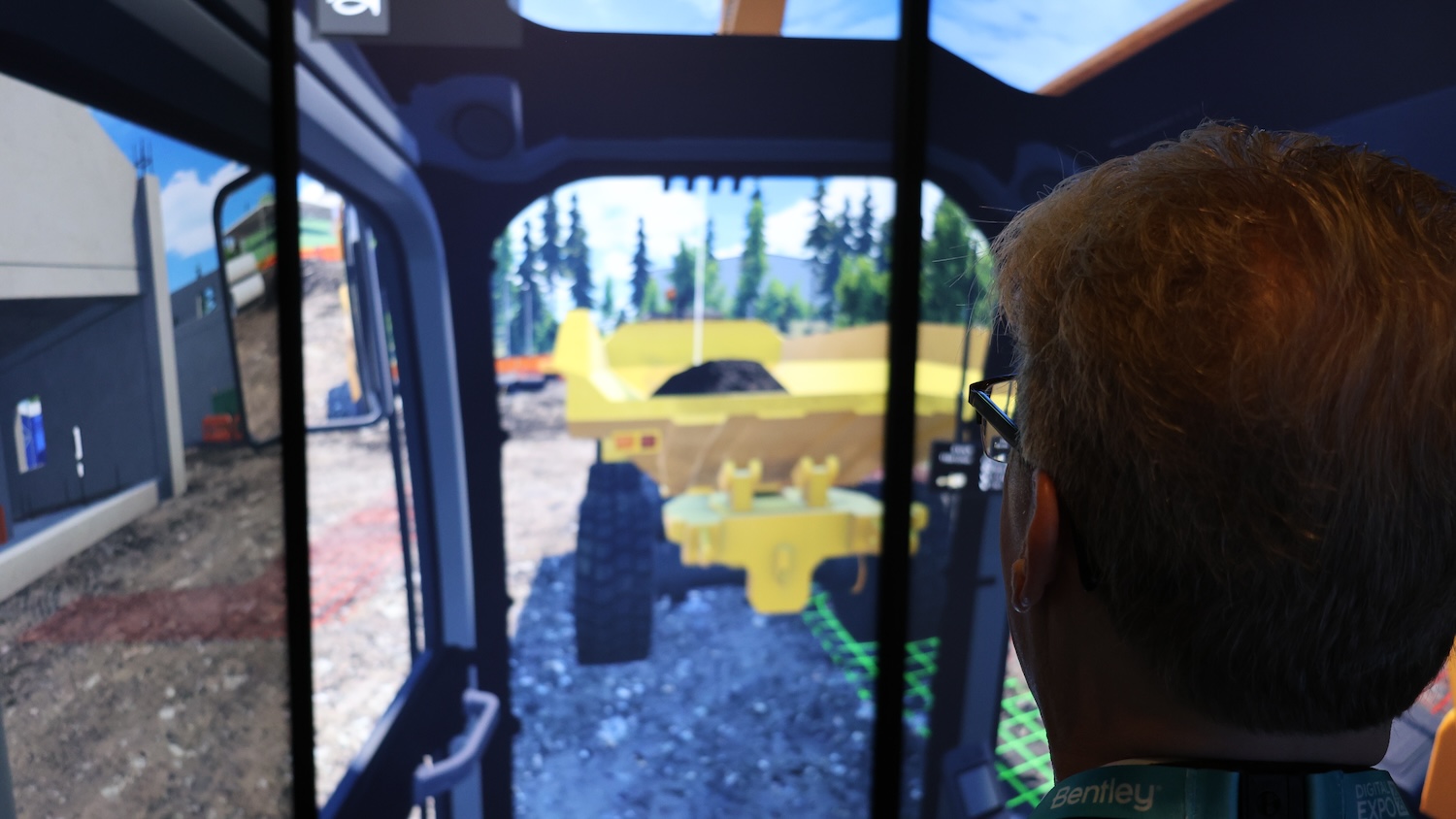
Select Plant Hire had a mini-excavator kitted out for maximum safety, and another demonstrating the Leica Geosystems machine control system that links to the project model (so the operator knows precisely where – and where not – to dig and how deep). For the record, this journalist had a go at the latter (see image above): suffice to say, the keyboard and mouse remain my tools of choice.
The Vertiq lift-in-a-box is another example of end-to-end digital delivery married to offsite processes. The premise is to solve the problem of lift design, construction and installation in the public transport realm. It starts with a parametric design which enables manufacture of a customisable exterior around a Kone lift – so red brick for London or yellow brick for the south-west, for example. The lift is built by Laing O’Rourke offsite and delivered to the project site, where it is craned into place and then commissioned.
The team from Expanded demonstrated its parametric tool for modular bridges. It takes the kit of parts approach to bridge design and construction. In the tool, the user starts by identifying the object to be crossed. From there, the user can move to the skeleton frame and select the beams based on the span, and so on. Ultimately, the tool provides a model for the Expanded team to develop the cost options for the bridge sections to be produced and the programme information for installation.
Laing O’Rourke claims substantial cost and programme benefits through using the tool, which is approved for use by National Highways and Network Rail.
For Laing O’Rourke, digital is a means to end – and perhaps more than one end. “Our purpose is to serve projects. We’re not here to do digital for the sake of digital. We’re here to make the boat go faster,” Drayton declares. “And all of these [digital] tools are a key part of making the boat go faster, doing it safer and,” he pauses for effect, “making it enjoyable and fun as well.”
“We need to start thinking about how we attract people [to construction]. It isn’t putting rigger boots on and pouring concrete for 60 hours a week. It’s designing digitally. It’s automating. It’s MMC. It’s all these things.”
If we are to attract a new generation to construction, digital technology and processes will be the hook. Drayton notes: “One of the event’s speakers is the director for education at Exeter University, who has highlighted the decline in applicants for architecture and civil engineering degrees. That’s going to cause us a real problem. We need to start thinking about how we attract people [to construction]. It isn’t putting rigger boots on and pouring concrete for 60 hours a week. It’s designing digitally. It’s automating. It’s MMC. It’s all these things.”
As we tour the expo, Drayton stops us opposite the CMBuilder stand. CMBuilder provides digitally-enabled, self-delivered site logistics planning. “Annabel Moss is one of our early talent digital engineers, building the Ellison Institute for Transformative Medicine in Oxford, sorting out logistics and machinery movement and lay down areas and so on. Annabel was being pulled in probably two, three days a week, for a couple of hours to basically hear what the team wanted and then model it.
“The great thing with CMBuilder is it’s self-delivered by the team. You know the sticker books for kids – a blank background, like a forest scene and you could stick a bunny rabbit and a log on it – that’s kind of what this allows you to do: it’s that simple. And the beauty of it is you don’t need a double PhD in clever digital stuff. It’s so simple you can put it in the hands of someone that isn’t incredibly digitally literate, and they can go through and do it and tell a story.
“That’s a huge thing for me: digital is such an effective storytelling mechanism – whether it’s the 4D sequence, how we’re going to do it, highlighting risks and going through and learning from risks, or communicating what the next couple of weeks looks like.”
As DC+’s tour finishes, Drayton concludes: “I’ve got 200-plus digital staff – I don’t necessarily need any more: I need the thousands of our colleagues to be comfortable and confident using the tools.”
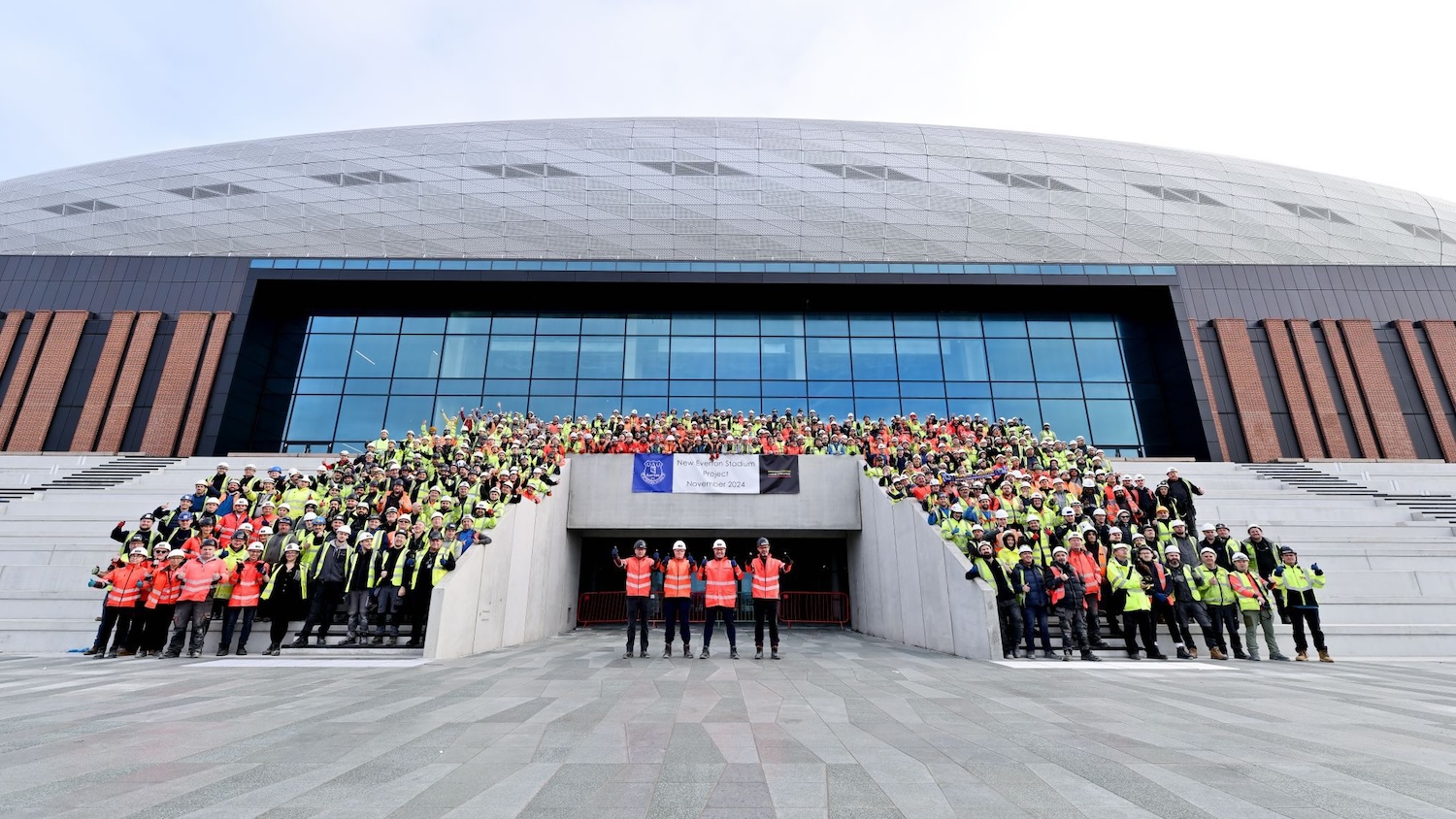
While Hinkley Point C is on-going, it’s fair to say that the new Everton Stadium was a halo digital project for Laing O’Rourke – an exemplar of the technologies and processes that can be implemented and what can be achieved.
DC+ asks Drayton what he thinks the contractor’s next halo digital project will be. He muses on the answer, adopting a wider lens: “The biggest pull I see is in healthcare with the New Hospital Programme and the digital hospital. I think there will be a massive step forward in digital, not just in the way that we deliver projects, but in the way that we operate hospitals.
“What you and I think of as a digital twin, and what a construction and a FM company or department think of as a digital twin, is about 10% of what the New Hospital Programme or the NHS think of as a digital hospital.
“If, as a sector, we manage to achieve the aspirations of the New Hospital Programme, I think that’s going to be the pathfinder, because it’s truly linking design with manufacture with operations. That’s end-to-end thinking – and that’s where I want to get to.”
DC+ catches up with Drayton a week after the expo. Did it deliver?
“I think the event smashed it out of the park,” he replies without hesitation. “The feedback from both my team and the wider Laing O’Rourke team has been ‘this has answered some questions that I had, this has opened my eyes to the realms of possibility’.
“Some of the comments we had back were ‘I had the most useful project-related conversations in a six-hour period the likes of which you would not get at a normal conference’. This was an educational event.”
While Drayton and his team had planned to bring different suppliers together formally, “the other amazing thing was seeing our suppliers seeking each other out: for example, how can CMBuilder work in Immersive Interactive’s space? Asite and Autodesk spent a lot of time talking to each other”, he reveals. “These connections will not only benefit Laing O’Rourke, but also the wider industry.”
It sounds like the clients enjoyed the expo too. Drayton says: “Feedback from our customers was fabulous. They loved getting an end-to-end view and seeing how digital supports delivery. I think they also valued spending time with each other: someone in charge of a healthcare scheme doesn’t usually get to spend time with someone from a nuclear power station or a data centre.”
Will there be another expo? One client told Drayton that the contractor needs to do it again next year and that it should be two days, with one day devoted to the wider supply chain and the other devoted to clients.
He notes that there is the opportunity to evolve the event beyond its initial digital brief, focusing on how Laing O’Rourke delivers projects from every angle, not just digital.
Drayton concludes: “I think we will do something. We got the engagement right this year, people learned something new. I wouldn’t want to do exactly the same thing again. Perhaps it could be a more formalised learning event, with masterclasses for example. I want people to leave not having had a jolly, but knowing stuff that they didn’t know before.”
Keep up to date with DC+: sign up for the midweek newsletter.