


How Amodal masterplanned information flow on British Land’s megaproject
24 February 2026

Alma-nac Architects has delivered the striking new Raymond Chandler Library for Dulwich College. It needed to meet exacting sustainability standards, share large models and engage stakeholders in the design, but how?
Dulwich College, founded in south London in the 1600s, is an independent boys’ school spread across a 32ha campus that has been developed and expanded over the years.
The school leadership wanted to redevelop the lower and junior school to provide a much-needed upgrade, with the first phase delivering a new library, ICT suite, two new classrooms and offices. Following detailed feasibility studies, Alma-nac developed a masterplan with the proposed project split into two phases.
The previous entry point for the lower and junior school was tired. Although the main building was structurally sound, it overheated in summer and was cold in the winter. Meanwhile, the existing library was located in an old, single-storey modular building; the space was bland and uninviting and was not well used by pupils.
The first phase involved removing the modular building and creating a new library for years 7 and 8, an ICT suite, two new classrooms and offices. Phase 2 includes plans for the refurbishment of existing classroom blocks, a new wellbeing centre, an administration wing and a new junior school hall.
Dulwich College has ambitious sustainability goals and wants to become net zero across its campus by 2030. The library building was seen as a pioneering project that set the precedent for subsequent phases of development and upgrade.
The school wanted the new building to achieve BREEAM Excellent, and with the team’s efforts, the completed project also met UK Green Building Council, LETI and RIBA net-zero targets.
At the start of the process, Alma-nac ran a series of workshops with both pupils and teachers to find out their needs. The results of those briefing sessions were brought into the proposed designs, including multi-functional spaces, long views and study nooks.

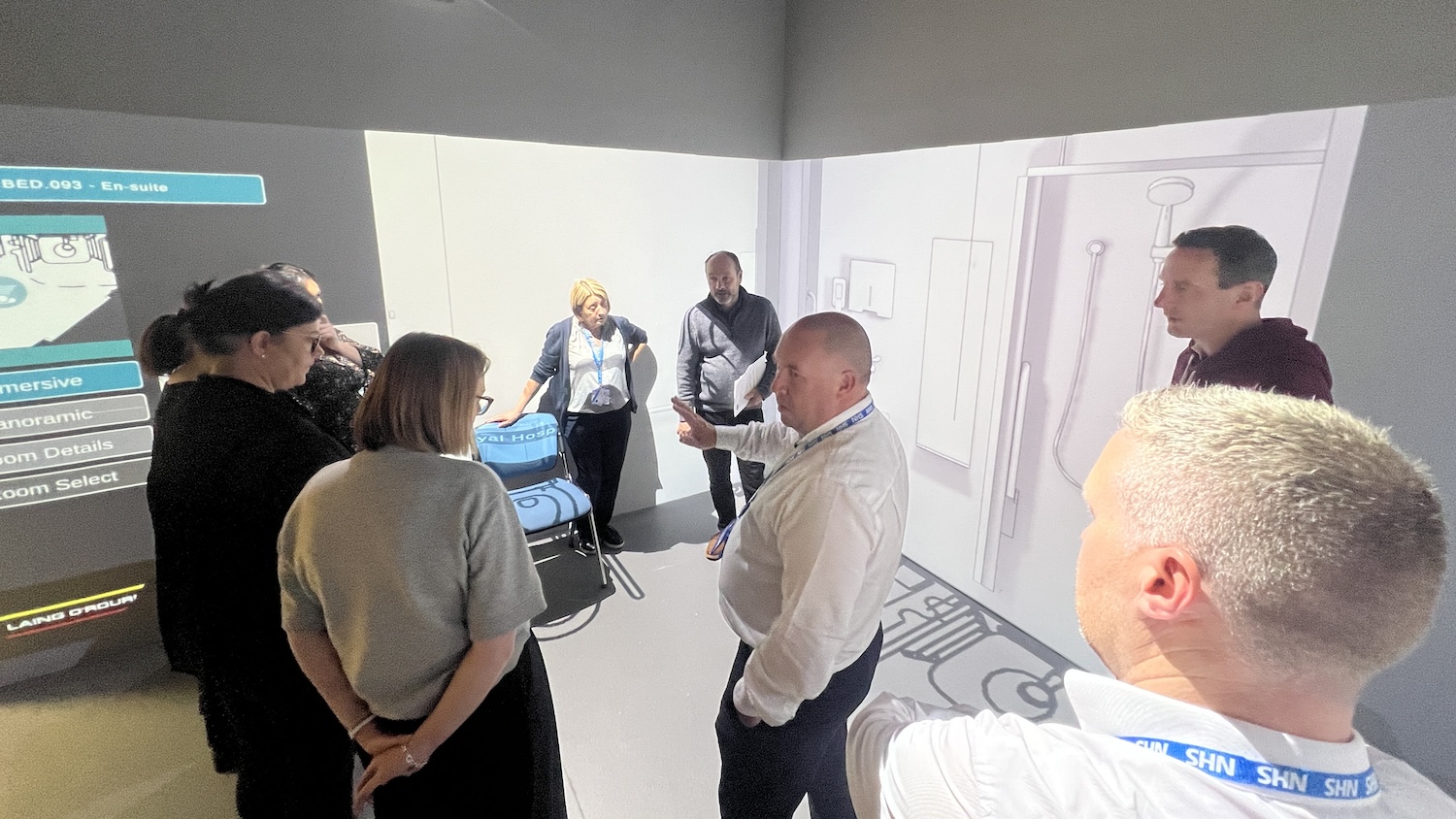
“We used the Archicad-Enscape plug-in and created a full walkaround model in Enscape. We used VR headsets that allowed the client to stand in parts of the building and enabled them to really engage with materials, light and scale of each space.”
A key part of Alma-nac’s brief was to ensure that both embodied and operational carbon for the new and refurbished buildings were kept as low as possible.
Designing in 3D in Archicad from the outset, Alma-nac tested three fabric options for the new library building: cross-laminated timber (CLT); concrete; and hybrid (including high-recycled-content lightweight steel, low-cement concrete decks and a glulam timber roof).
Working closely with building consultants HRW Engineers and Max Fordham, Alma-nac carefully examined each option and compared heating and cooling requirements, overall material use, cost and design aesthetic. “Archicad allows us to test different designs very quickly, so we can provide clients with the risks and benefits for each option,” explains Adam Shapland, associate at Alma-nac.
In the early stages of design, the team geolocated the model and carefully examined light levels and daylight quality. The aim was to bring in plenty of natural light, and the initial designs included much more glazing at the top of the building. Modelling by Max Fordham revealed that this would have resulted in overheating, so Alma-nac reworked the design.
Throughout the project, Alma-nac regularly shared the BIMx model and IFC with the external consultants, helping to improve communication, demonstrate design intent and troubleshoot problems. “We shared the BIMx and IFC model with the consultants we were working with. There’s a huge amount of value in having both the Archicad model and the full BIMx model to refer to,” Shapland adds.
Ultimately, the team opted for a hybrid structure. With a lightweight steel frame, thin concrete decks and an exposed glulam roof structure, the building used fewer materials.
While building a fully CLT library would have meant less embodied carbon, it also meant less potential for passive cooling, as the thermal mass would be lower. Shorter spans were also necessary with CLT, which meant more columns and deeper beams in the double-height library space.
The final result is a light-filled library with exposed timber that provides a calm learning environment, while also demonstrating to pupils how the roof is held up.
Powered 100% by electricity, the library is fitted with an air-source heat pump and a mechanical ventilation and heat recovery (MVHR) system. The next phase of the project will include photovoltaic panels for electricity generation.
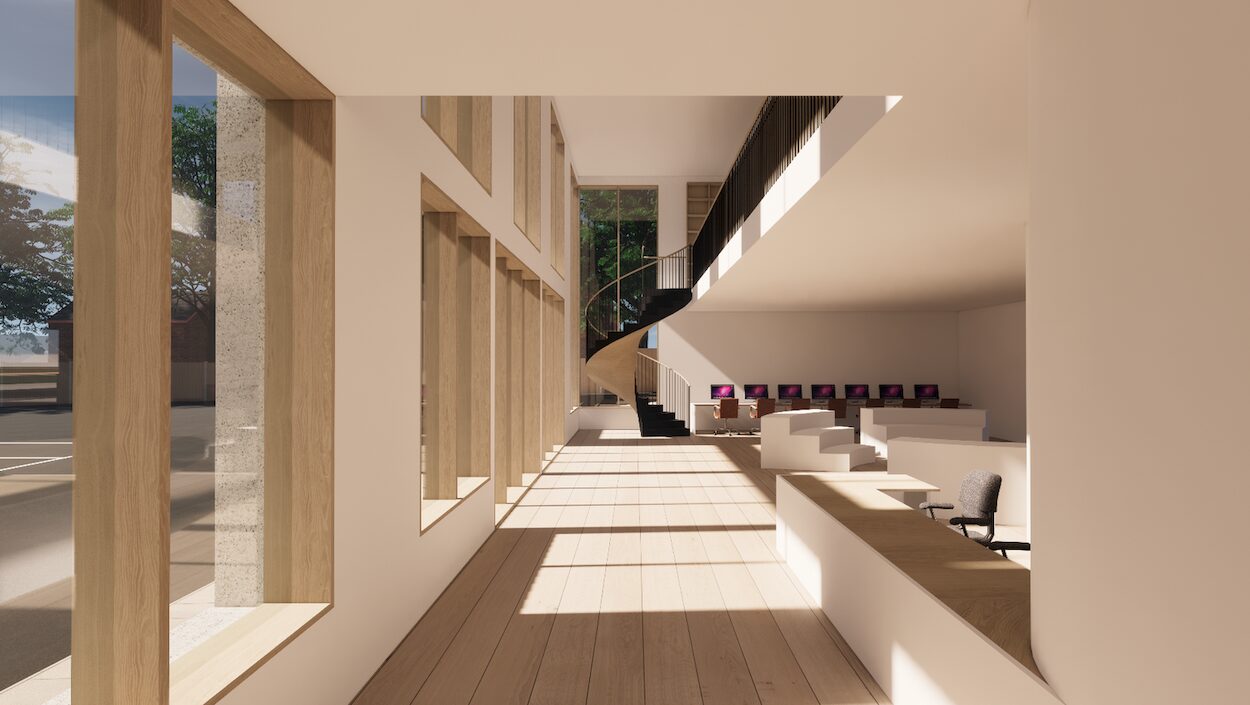
Alma-nac used Enscape to render the Archicad designs, to create realistic visualisations that the school leadership team could experience. “We used the Archicad-Enscape plug-in and created a full walk-around model in Enscape. We used VR headsets that allowed the client to stand in parts of the building and enabled them to really engage with materials, light and scale of each space, and they were very impressed,” Shapland says.
Although the project was divided into two distinct phases, Alma-nac modelled everything in one Archicad model. The result was a very detailed Teamwork project, and one large file that required careful coordination with the M&E and structural consultants. Alma-nac exchanged information with the consultants via IFC and managed any clashes directly within Archicad.
Shapland says: “As a B-Corp architecture practice, we have ambitious sustainability goals. We aim to design all our buildings to be better than Part L. We’re building this into our Archicad template, and will model our preferred composites as favourites. We spend a lot of time scheduling different building materials, and we are working with Graphisoft to develop a quicker workflow to do that.
“As a practice, we have worked closely with the Department for Education to examine the issues of overheating and CO2 build-up in classrooms. Many schools have the heating on full all the time, so classrooms are typically much hotter than they need to be.
“Looking ahead, we need to design passively resilient buildings. For schools, this means designing buildings with more thermal mass and smarter passive ventilation systems, so we don’t need to have air conditioning in every block. It also means designing in solar shading to protect from the heat in summer.
“Since occupation, we are gaining a clearer understanding that the building’s ongoing energy performance depends not only on its design, but also on its operation. It is essential that both operators and users fully understand the building systems to ensure they function as intended and the building performs as designed.”
“Graphisoft was on hand to advise us on the best way to manage such a large model in Archicad, and offered plenty of support both via the helpdesk and in person. This was the largest project we had done in terms of scale and cost. It was therefore a learning process with respect to modelling and coordination,” Shapland explains.
Alma-nac used a point-cloud survey to get a very detailed view of the existing site. The team brought the point-cloud model directly into Archicad and used it to coordinate directly with the steel manufacturers to ensure accuracy. “It was very useful both in terms of modelling the existing building and once we were on site to have the point cloud model to refer back to,” he says.
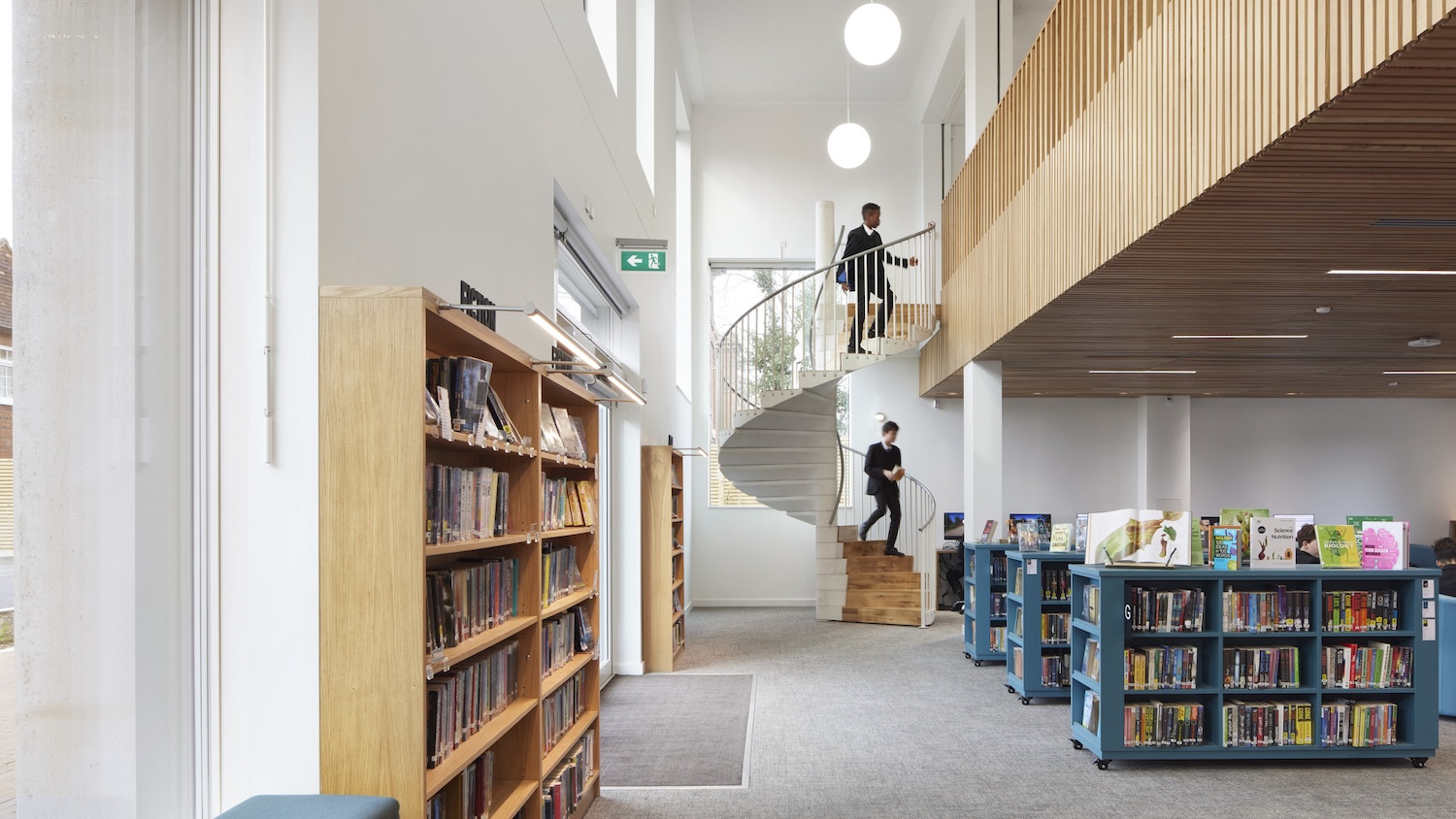
Completed in 2024, the Raymond Chandler Library is a light-filled, double-height space with a flexible design. It has become the heart of the lower school, a new common room for studying, reading and socialising.
The natural materials are accented with pops of colour, while the bespoke spiral staircase provides an elegant feature. Meanwhile, the first floor benefits from long views across to the City of London, open spaces and study nooks for individual learning.
With fresh-air ventilation, the spaces are comfortable and pleasant to be in, remaining cool in summer and warm in winter. Built to Passivhaus principles, the building now costs less to heat and cool than before.
Moreover, the new library has proved hugely popular with pupils, and the number of books being borrowed has doubled.
The project was recently shortlisted for the RIBA London Awards 2026.
Keep up to date with DC+: sign up for the midweek newsletter.