



Sizewell C adopts Asite CDE in drive for consistent information
17 November 2026

Glider Technology launches a free asset intelligence framework at Digital Construction North (DCN) in Manchester today. The framework sets out how building information should be managed and used across the whole life of an asset.
The asset intelligence discipline is the brainchild of Glider founder and managing partner Nick Hutchinson. It is described as “the discipline that ensures the people responsible for buildings can find, trust and act on the information they need to keep them safe, compliant and performing”. Glider introduced it publicly at Digital Construction Week in London five months ago.
The framework addresses the gap between the information that organisations hold about their buildings and the information that they can confidently act on. This is called the performance gap, driven by information that:
Glider notes that handover gets most of the industry’s attention, but it happens only once. On the other hand, FM contracts are re-procured every three to seven years, and each new contract is a point where information either carries across or degrades. “Every fit-out and equipment replacement adds records that are rarely reconciled with what already exists,” Glider states.
The framework offers two routes. First, the ‘create’ pathway applies to new build and major refurbishment, where structured information is captured, so it serves the building in operation as well as at handover. Second, the ‘recover’ pathway applies to existing buildings, where information is missing, fragmented or unreliable and needs to be rebuilt. The framework treats recover as the dominant condition, because most operational buildings will never be subject to another capital project.
The asset intelligence discipline is intended to complement the 55001 and 19650 standards while replacing neither. The framework is independent of any software platform, including Glider’s own. The architecture describes five functions – requirements, capture, information governance, delivery and use – and 15 capabilities. A maturity model rates each function on five levels and gives a profile rather than a single score. The framework’s own reading of the market is that most organisations sit at Level 1 or 2 across most functions, and that very few yet use their information to measure the outcomes that their buildings deliver.
Hutchinson, founder and managing partner of Glider, created the discipline. He said: “I have spent more than 20 years watching information move through the life of buildings, from large capital projects to the decades of operation that follow. The biggest job of my career was repatriating over 12 million documents from out-going FM contractors back to a government estate owner. It took almost three years, and it showed me how little of what an organisation holds it can actually rely on. The industry was missing a practice that carries information through every handover, fit-out and contract change for the whole life of a building. Asset intelligence is that practice. Publishing the framework openly means anyone can use it, test it against their own estate and tell us where it falls short. Each edition should be better than the last because of that.”
The framework is already in use. Bryn Turner, asset management lead at Defence Infrastructure Organisation (DIO) Accommodation, gave feedback on the framework during its development. He said: “The asset intelligence discipline is the first framework I have engaged with where the people ultimately responsible for buildings, the asset owners, are put at the centre of its purpose. Historically the focus has been on provider-to-client-style relationships. This stood out to me as different. It recognised that asset owners are the ones who, in the end, must retain, recall, use and critically trust information about their assets. For DIO Accommodation, the asset intelligence discipline represented a framework around which we could build our asset data and information recovery programme.”
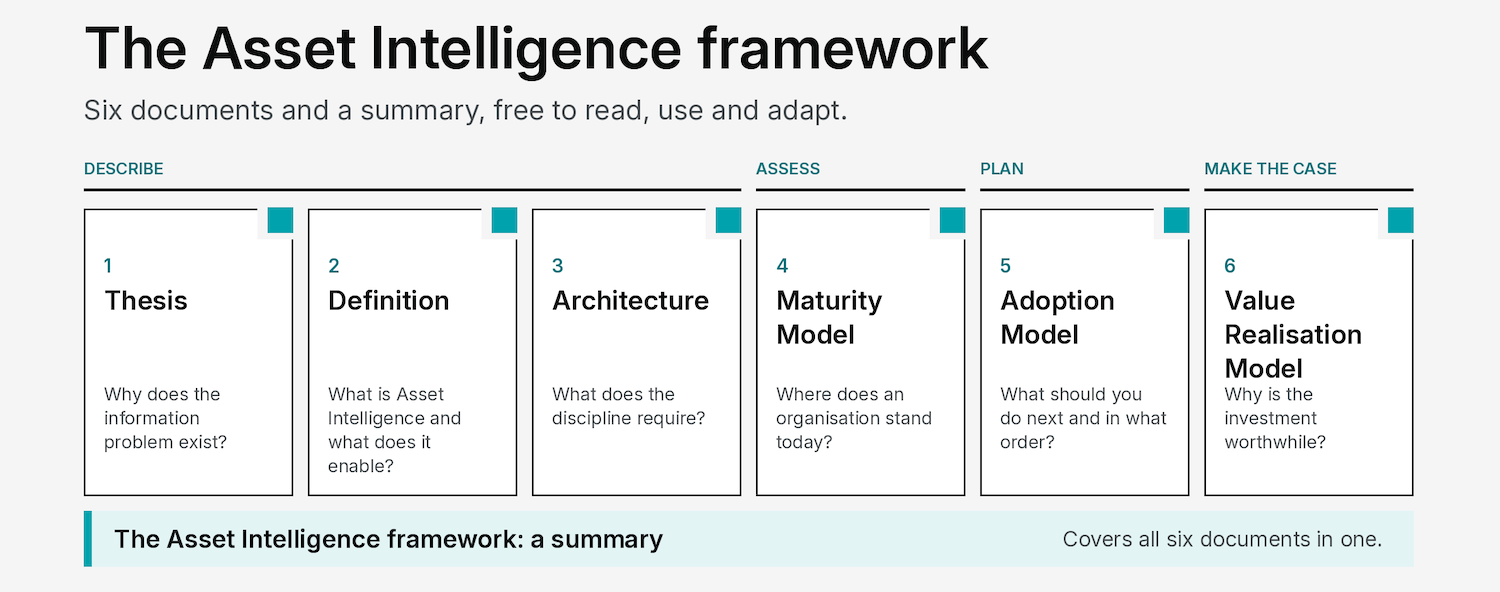
Edition 1 of the framework is made up of seven documents. Six set out the discipline itself: the thesis, the definition and the architecture, plus three models covering maturity, adoption and value realisation. The seventh summarises all six. Each is published under the Creative Commons Attribution 4.0 International licence (CC BY 4.0) and can be read online or downloaded as a PDF.
Glider authors and stewards the framework, external reviewers challenge its substance, and the framework is reviewed every year, with a new edition published when one is warranted. From today, the wider industry can contribute. Organisations that want a quick view of where they stand can use the free asset intelligence maturity indicator.
Keep up to date with DC+: sign up for the midweek newsletter.